News Feed Articles

Michelangelo Pistoletto receives nomination for 2025 Nobel Peace Prize.

Italian artist Michelangelo Pistoletto has been nominated for the 2025 Nobel Peace Prize. The 91-year-old artist, a pivotal figure in Arte Povera, was nominated for his belief in art as an essential tool for peace. The artist positions art as a catalyst for significant social and environmental consciousness. First awarded in 1901, the Nobel Peace Prize will celebrate its laureates in a ceremony on December 10th, commemorating Swiss inventor Alfred Nobel’s death.

“I do not see my nomination for the Nobel Peace Prize as a personal recognition for what I have done so far, but as a commitment to future work,” said Pistoletto. “Art must take on a leading role in driving a radical transformation that fosters a shared and responsible concept of humanity, promoting peace as a self-certified expression of intelligence. I do not know if we will ever achieve peace, but simply working towards it already makes me feel better.”

Born in Biella, Italy, in 1933, Pistoletto first rose to international prominence in 1962 with his “Mirror Paintings” series. Around this time, the artist began working with legendary Romanian American dealer Ileana Sonnabend and began developing perhaps his earliest work associated with the Arte Povera movement: the “Oggetti in meno” (“Minus Objects”) sculptures. The artist presented his first solo exhibition in the United States at the Walker Art Center in 1966 and mounted a presentation at the São Paulo Bienal in 1967.

Throughout his career, Pistoletto has been a staunch advocate for collaboration among artists. He champions a vision called the “Third Paradise,” which sees peace as emerging from social and human collaboration. This philosophy highlights art’s ability to bridge societal divides and build global unity. In the 1990s, he founded Cittadellarte, an initiative that integrates art into various social sectors to drive responsible change, in his hometown.

“For me, the culture of peace is present in all artistic activities, always connected to every aspect of social life, which I have personally developed—from the ‘Mirror Paintings’ to my work at the Vienna Academy, up to the foundation of Cittadellarte,” said Pistoletto. “It is not necessary to use the word ‘peace’ in every project, but rather to act in a way that genuinely achieves it, by working towards continuous, peaceful progress, expanding globally across all areas of society.”

New York–based gallery Lévy Gorvy Dayan is currently showing a major solo exhibition of the artist titled “To Step Beyond,” which is on view through March 29th. One of his representing galleries, GALLERIA CONTINUA, has staged exhibitions of his work in Paris, Beijing, São Paulo, Rome, San Gimignano, Dubai, and Havana in 2023 and 2024. Other recent Pistoletto shows have been held at Robilant+Voena in 2024, Castello di Rivoli in 2023, and Simon Lee Gallery in 2022.

News Feed Articles

What Sold at Frieze Los Angeles 2025

Frieze Los Angeles 2025 closed its sixth edition on Sunday, February 23rd, capping off a buoyant L.A. Art Week, which saw collectors, celebrities, and institutions turn out in force across the city. The fair took place following concerns that recent wildfires might impact turnout. Yet the event witnessed a substantial gathering of visitors, with high-profile collectors and celebrities, including Adrien Brody, Gwyneth Paltrow, Kid Cudi, and Julia Fox.

This year’s Frieze Los Angeles hosted some 97 galleries from 20 countries at the Santa Monica Airport, and took place during a week of exhibitions and other art fairs across the city, including Felix and Post-Fair. The total number of exhibitors at Frieze was identical to last year’s edition and slightly lower than the 2023 count of 120 galleries. Robust dealmaking across the fair reflected an optimistic attitude among galleries, reinforcing a sense of resilience in the L.A. art market. “The energy, interest, and enthusiasm were palpable, with a strong showing of collectors, institutions, and artists,” said Angela Brazda, director of White Cube.

Leading the reported sales across the fair was a $2.8 million Elizabeth Peyton painting at David Zwirner’s booth during the flurry of first-day transactions. The sale surpassed last year’s most expensive reported transaction of $2 million for a Richard Serra drawing at Gladstone Gallery. This year’s fair also saw several sold-out presentations from David Kordansky Gallery and Casey Kaplan, among others.

“I was rooting for this fair to happen,” said Tim Blum of the Los Angeles–founded gallery BLUM. “I knew quite clearly that it would be an important event—it always is, but ever more so this year after the devastating fires. I kept my expectations in check, given the circumstances, but I was heartened when I walked up on opening day to see a serpentine line winding down the entrance ramp. Ultimately, there was a very vibrant, energetic crowd at the start of the fair as well as in days that followed. Frieze Los Angeles this year was a win.”

A noteworthy new acquisition program was the Mohn Art Collective (MAC3), a joint initiative by the Los Angeles County Museum of Art, MOCA, and the Hammer Museum. This fund, amounting to $75,000, acquired two works from the Focus section: Shaniqwa Jarvis’s Slowly, Surely (2025) from Sow & Tailor and Edgar Arceneaux’s Skinning the Mirror (Summer 1) (2025) from Dreamsong—one of Artsy’s best booths from the fair.

“Frieze Los Angeles was a resounding success,” said Christine Messineo, director of Americas for Frieze. “Collectors and institutions engaged with real intent, purchasing with sustained interest throughout the fair, from the opening moments to the final hours on Sunday afternoon. The market has proven its resilience. In the face of recent challenges, the global art community has recognized the vital role of investing in the creative economy.”

Here, we round up the key sales reported by galleries at Frieze Los Angeles 2025.

Top sales at Frieze Los Angeles 2025

Untitled, 2015
Noah Davis

David Zwirner

  • In addition to the Peyton work, David Zwirner’s sales included a Noah Davis work for $2.5 million, an Alice Neel painting for $1.8 million, and a Lisa Yuskavage painting for $1.6 million. The gallery also reported the sales of two works on paper by Kai Althoff priced at $150,000–$400,000, and a piece by Emma McIntyre for $100,000.
  • Gladstone Gallery’s reported sales were led by a Keith Haring painting on glass for $2 million. The gallery also sold “several” Robert Mapplethorpe photograph editions priced at $200,000–$300,000 apiece and a Ugo Rondinone painting for $240,000.
  • Xavier Hufkens’s sales were led by a Tracey Emin painting for “approximately” £1.2 million ($1.5 million). The gallery also sold a sculpture by Antony Gormley for £375,000 ($474,000); two paintings by Sterling Ruby for $140,000 and $85,000; two paintings and a sculpture by Mark Manders for €30,000–€110,000 ($31,400–$115,000) each; and a painting by Sayre Gomez for $60,000. The gallery sold out its presentation of paintings by Constantin Nitsche for prices ranging between €15,000–€50,000 ($15,700–$52,500).
  • Thaddaeus Ropac’s reported sales were led by a painting by Georg Baselitz for €1 million ($1.04 million) and a painting by Alex Katz for $800,000.

Sold-out booths at Frieze Los Angeles 2025

Theatre of Metamorphosis, 2024
Xin Liu (b. 1991)

Make Room

More notable sales from Frieze Los Angeles 2025

Fall Mountains, 2024-2025
Diana Al-Hadid

Kasmin

Around the clock in amsterdam blue, cobalt, and sevres blue, 2025
Loie Hollowell

Jessica Silverman

Benefit sales at Frieze Los Angeles 2025

Following the recent wildfires in L.A. County, Frieze Los Angeles this year featured several initiatives to direct support to those affected. These included partnerships with organizations including the Black Trustee Alliance for Art Museums as well as the inauguration of the Frieze Arts Alliance, where major institutions committed to supporting local artists and galleries. At Victoria Miro’s group presentation “Galleries Together,” exhibitors and artists across the fair were invited to contribute works, with proceeds benefitting the L.A. Arts Community Fire Relief Fund. Works sold through this initiative included:

  • Victoria Miro sold Tidawhitney Lek’s Made in Cambodia (2024) and Jemima Murphy’s Life in Violet (2024) for $15,000–$20,000 apiece.
  • Lehmann Maupin sold Liza Lou’s Sunday Afternoon (2013) for $25,000.
  • David Kordansky Gallery sold Maia Cruz Palileo’s Spotted Aspin (2024) for $8,000.
  • Kaikai Kiki Gallery sold Tomoyumi’s Sunday Afternoon (2023) for $17,000, Chinatsu Ban’s Baptism in Mexico (2022) for $5,700, Ban’s Close Encounters of the Third Kind for $1,900, and works by Shin Murata and Takashi Murakami for $3,000 each.
  • L.A. Louver sold Rebecca Campbell’s Salmon River Gold (2023) for $8,500.
  • Galerie Lelong & Co. sold Tariku Shiferaw’s Keep Ya Head Up (Tupac) (2019) for $5,000.
  • 303 Gallery sold Erin Falls and Sam Falls’s Concord (2025) for $3,000.
News Feed Articles

The 10 Best Booths at Frieze Los Angeles 2025

Two themes dominated art world conversations in the run-up to this year’s Frieze Los Angeles. First came the question of whether the fair would proceed in the wake of wildfires across L.A. County, which devastated over 40,000 acres and destroyed more than 10,000 homes. Then, when the fair announced that it would go ahead, there was the matter of quite how things would shake up.

As Frieze Los Angeles 2025 held its VIP day on February 20th, the mood was one of vibrancy and communality. Major collectors, museum curators, and A-list celebrities like Gwyneth Paltrow, Al Pacino, Kid Cudi, and Katie Couric swarmed the Santa Monica Airport to peruse works presented by some 101 exhibitors.

This year’s fair comes as the L.A. art scene has remained steadfast in its commitment to its arts community. Ahead of the fair, artists, galleries, and institutions have come together in a concerted effort to fundraise and provide relief. Frieze made the decision to proceed as planned with the fair after consultations with local stakeholders. Meanwhile, Felix Art Fair and the new Post-Fair, along with a slate of impressive exhibitions across the city this week, also chose to continue.

“What was crucial to the decision was…many conversations with the institutions here in Los Angeles, the galleries here in Los Angeles, and there was a real call to action that the community needed a galvanizing moment around the art world,” Christine Messineo, director of Frieze Americas, told Artsy. “And we were ready to show up.”

Since its debut in 2019, Frieze Los Angeles has become a linchpin for the city’s art scene, a fact that is all the more evident in the aftermath of the fires. “Community building has always, always been inherent in the DNA of Frieze Los Angeles,” said Messineo. “L.A. does not exist without our galleries, our institutions, our nonprofits, and our artists, and we want to be a space to welcome all of those into those organizations,” she added.

As well as the main galleries section, Frieze Los Angeles 2025 also features Focus, curated for the second time by the renowned Essence Harden. This segment showcases 12 solo exhibitions, several of which highlight remarkable work from Los Angeles artists. In addition to this section, Frieze has expanded its special projects initiatives with a program of fundraising and community-led projects, including Summaeverythang, AMBOS, and the Frieze Impact Prize.

The VIP day kicked off with a flurry of reported sales, led by a $2.8 million Elizabeth Peyton painting at David Zwirner’s booth. Read our roundup of day one sales from the fair here, and stay tuned for our comprehensive recap of reported sales on Monday.

Here, we present the 10 best booths from Frieze Los Angeles 2025.

Make Room

Booth F4

With works by Xin Liu

The centerpiece of Los Angeles tastemaker Make Room’s standout booth is Artsy Vanguard 2025 artist Xin Liu’s Theater of Metamorphosis (2024), a remarkable triptych featuring a bronze cast of the artist’s mouth mounted on a fleshlike canvas. Leveraging her background in engineering, Liu integrated a cooling mechanism into this piece, chilling the bronze to negative four degrees Celsius. Part of her “cryo body” series, this system draws moisture from the air to transform the appearance of the work over time, playing with themes of the body and self-preservation.

Another piece from the same series, Primula Flowers (2024), features an identical bronze mouth against a canvas of skin-like resin painted in soft blues and reds that are reminiscent of veins. Midway through the VIP day, the bronze was coated in ice, forming a protective layer over the raw bronze. For the artist and Make Room founder Emilia Yin, these works resonate with Los Angeles’s health-obsessed culture.

Primula Flowers, 2024
Xin Liu (b. 1991)

Make Room

Fortune Tellers: Agua Viva , 2025
Xin Liu (b. 1991)

Make Room

Theatre of Metamorphosis, 2024
Xin Liu (b. 1991)

Make Room

“The decision of presenting this ‘cryo body’ work in that way had a lot to do with Los Angeles, the frontier of technology for life-preserving,” said Yin. “We have people who are so into every possible way to optimize life and health.”

Complementing these works is Fortune Tellers: Agua Viva (2025), featuring the artist’s DNA printed on rice paper, adorned with threads, and inscribed with poem-like texts. These technology-based works are priced between $20,000 and $50,000.

Gagosian

Booth D7

With works by Chris Burden

Fairgoers seeking a moment of respite from its packed aisles should not miss Gagosian’s booth. The mega-gallery has opted to present a dramatic installation by the late Californian artist Chris Burden, Nomadic Folly (2001), which was initially created for the seventh Istanbul Biennale. Tearing down the traditional fair booth walls, the gallery has erected a four-room structure adorned with colorful handmade carpets, embroidered wedding fabrics, plush pillows, braided ropes, and jewel-toned glass and metal lamps. These materials are set on a platform of Turkish cypress beneath large umbrellas, complemented by traditional music.

The genesis of the work is as compelling as its presentation. Burden traveled to Istanbul on September 9, 2001, just days before 9/11, and immersed himself in the local markets, selecting silk panels, carpets, and lanterns to construct the architectural installation. Senior director Deborah McLeod, calling the work an “homage to cultural relativism,” noted its heightened relevance to today’s global hardships.

“This work had healing powers at the time, and we thought this was a work that Chris felt was showcasing all the right things about humanity in a time of crisis,” said McLeod. “And here we are in a devastating moment in Los Angeles, so we thought, ‘What a beautiful gesture.’ Chris Burden is the ultimate L.A. artist, so we felt it made sense to bring it to Frieze L.A.” The entire installation is for sale for an undisclosed amount.

James Fuentes

Booth D3

With works by Pat Lipsky, Jim Jarmusch, and Kikuo Saito

At the booth of Los Angeles and New York gallery James Fuentes, a series of paintings by the 83-year-old Color Field painter Pat Lipsky are an instant highlight. Fuentes first met Lipsky when the painter visited the gallery’s Tribeca location for its solo show of works by the late artist Kikuo Saito, her old friend and colleague.

The booth features three of Lipsky’s large abstract Color Field paintings, heralding an exploration into the artist’s significant body of work. The standout piece is Chrysanthemum (1971), one of the earliest examples of the wave-like forms that would come to define her style, displaying a vibrant gradient of reds, greens, oranges, and blues on a tan canvas. This work is flanked by two more recent paintings from 2023: the sun-soaked orange Message and the moodier Winged Fantasia. These pieces are priced between $125,000 and $150,000, with Chrysanthemum selling on the VIP day. Coinciding with the fair, the gallery is also hosting its inaugural exhibition with Lipsky, titled “That Which We Are,” at its Los Angeles location.

Untitled, 2017
Jim Jarmusch

James Fuentes

Outside the booth, a 2011 painting by Saito, Vilgot, and an untitled collage by filmmaker Jim Jarmusch are displayed, priced at $140,000 and $7,000, respectively. Reflecting on the fair’s significance, Fuentes commented on the strength of L.A. “It’s evidence of L.A.’s resilience and the trajectory of L.A. being a city that’s going to continue to thrive,” Fuentes said. “It’s been even more meaningful than any other Frieze than I can remember for that reason.”

Dreamsong

Booth F12

With works by Edgar Arceneaux

Los Angeles–based artist Edgar Arceneaux makes a habit out of smashing mirrors. He applies paint to canvas to the backs of mirrors containing silver nitrate. These are then broken, and the nitrate is transferred onto the face of the canvas, culminating in the works for his “Skinning the Mirror” series. Minneapolis gallery Dreamsong presents seven pieces from the series in a shattering display. Arceneaux created these works during a 2024 residency at the Walker Art Center in Minneapolis, where he became captivated by the seasonal changes of the region—a stark contrast to his native Southern California.

A notable piece from the series is Skinning The Mirror (Summer 1) (2025), which measures approximately 6.5 by 10 feet. This work features cracked mirrors interspersed with bursts of red and yellow paint seeping through the fractures. It was acquired during the fair’s VIP day by the Mohn Art Collective, in collaboration with the Los Angeles County Museum of Art, MOCA, and the Hammer Museum, through the MAC3 fund. Another striking piece, Skinning The Mirror (Winter 9) (2025), is a more subdued, tan monochrome abstraction. By the end of the VIP day, it had been acquired through the City of Santa Monica Art Bank Acquisition.

“Sales have been strong, and it’s been incredibly busy. I’m a bit overwhelmed at the moment,” gallery co-founder Gregory Smith told Artsy. “The energy is fantastic so far. Edgar is from South L.A. and has worked here for decades. It was really nice to bring work he made where we’re from to the place where he’s from and show it here because we all have sort of different connections to him.” Prices for the works in this series range from $16,000 to $100,000.

Richard Saltoun

Booth D4

With works by Greta Schödl

Austrian artist Greta Schödl is perhaps best known for her contributions to the poesia visiva (visual poetry) movement in Italy. At the age of 95, she continues to infuse her sculpture and works on paper with language, often simply symbolic and nonsensical. For instance, in her presentation at Richard Saltoun’s booth, Schödl presents six marble stones engraved with the Italian word for marble, marmo, each letter “o” meticulously filled with gold leaf. These works, made within the last five years, are priced at $10,000 apiece.

Her piece La Scala (Serie VIBRAZIONI) (ca. 2014) embodies her concepts of symbolism and design without utilizing the written word. This 10-foot-tall scroll features meticulously designed wave-like patterns created with Indian ink. The long paper is segmented by gold crochet, adding a textural dimension, and is anchored by a piece of wood at the base of the work. It is priced at $26,000.

Senza titolo [No title], 2020s
Greta Schödl

Richard Saltoun

Untitled (Serie Scritture), 2024
Greta Schödl

Richard Saltoun

Untitled, 2020 c.
Greta Schödl

Richard Saltoun

Animali Fantastici [Fantastic Animals], 1975
Greta Schödl

Richard Saltoun

Still, Richard Saltoun presents a wide selection of the artist’s experimental language-based works on paper. For instance, some untitled works from the 1980s feature painted papers filled with handwritten cursive phrases adorned with cut-out collaged sentences and gold leaf arranged in geometric patterns. These works are priced at $10,000, and works in the booth range from $3,000 to $50,000.

Roberts Projects

Booth E9

With works by Luke Agada, Amoako Boafo, Daniel Crews-Chubb, Lenz Geerk, Suchitra Mattai, Wendy RedStar, Betye Saar, Kehinde Wiley, and Brenna Youngblood

An immediate standout at Roberts Projects’s booth is an installation by Betye Saar that features two mixed-media assemblage works: the small rocking chair Critter Chair: The Seat of the Spirit (1990) and the windowpane sculpture Fragments of Fall (1989/1999). Originally featured in the “Sanctified Visions” exhibition at MOCA in 1990, the installation draws on the life of American writer Zora Neale Hurston. Here, the gallery reconstructs an evocative environment with moss and corrugated sheet metal, mimicking aspects of Hurston’s childhood surroundings. The purpose of mounting such a historically embedded exhibition, said the gallery’s founder Bennett Roberts, is to emphasize the vital history of the city.

“It’s all about memory and remembering,” Roberts told Artsy. “I think that’s the thing about L.A. is that we always go through these problems, but we always seem to come out stronger and better. So, we decided to use it after all of this happened and create it as an environment that’s about remembering.”

Lodge Pole, 2024
Wendy Red Star

Roberts Projects

Japonica Round Neck, 2023
Amoako Boafo

Roberts Projects

Fragments of Fall, 1989/1999
Betye Saar

Roberts Projects

Evening Star I, 2025
Wendy Red Star

Roberts Projects

under the same rain, 2025
Suchitra Mattai

Roberts Projects

The rest of the group presentation features highlights from the Los Angeles–based gallery’s program. This includes Wendy Red Star’s Evening Star #1 (2025), which features two mirrors positioned at a 90-degree angle, reflecting a star quilt pattern crafted from earth pigments in rich shades of blue and red, inspired by Apsáalooke (Indigenous Americans that primarily live in Montana) women’s rawhide paintings and quilting techniques. The price range for Red Star’s works starts at $9,000, extending to Amoako Boafo’s portrait Japonica Round Neck (2023), priced at $205,000.

Proyectos Monclova

Booth E13

With works by Víctor Hugo Pérez

Mexican artist Víctor Hugo Pérez’s portraits of his wife and pets, such as Mujer con gata (2018), are anything but ordinary. Here, his wife and cat are depicted with nightmarish features: eyes on the same side of their faces, wide toothy jaws, all set within ominous black frames adorned with gold leaf. These frames are hand-carved, featuring a menagerie of animals from birds to cats. Mexico City powerhouse Proyectos Monclova presents a series of these unsettling portraits for its exceptional Frieze Los Angeles presentation.

Pérez often focuses on unsettling and grotesque representations of mythical female figures (his wife stands in as the model for these portraits). These figures are inspired by pre-Hispanic mythology and biblical references, such as Lilith or Eve. For example, Lilith (2024) portrays Adam’s first wife surrounded by two birds and two demonic-looking dogs, imbuing the piece with a sense of mythic drama.

Lilith, 2024
Víctor Hugo Pérez

PROYECTOS MONCLOVA

La intocable rata, 2023
Víctor Hugo Pérez

PROYECTOS MONCLOVA

Central to the booth is a selection of ceramics crafted in Tonala, Jalisco, using a traditional black clay technique. Pérez imbues this traditional technique with his distinctive contemporary expressionist style, adorning these works with animal motifs and abstract forms. A standout piece, La intocable rata (2023), features a ceramic rat poised regally atop the vessel, priced at $6,000.

During the VIP day, the gallery saw robust sales, with almost half of the artworks sold at its midpoint. “We’ve had the best response,” said Alexandra Lovera, the gallery’s sales director. “We didn’t know what to expect when we came because of everything that happened with the fires, but the response has been unbelievable. The people have incredible energy. They’re buying, they’re excited, so we couldn’t be happier.”

Anthony Meier

Booth D5

With works by Saif Azzuz

The elaborate, 17-foot-wide salon-style assemblage by Libyan Yurok (an Indigenous people of California) artist Saif Azzuz, What Memories Hold (2024), attracted eager audiences to Anthony Meier’s booth throughout Frieze’s VIP day. This installation combines sculptural assemblages that feature Yurok patterns with wooden carvings of animals, while also introducing some metal flower reliefs, a newer medium for Azzuz. Sentimental details in the works also stand out. “He’s really family- and community-focused, and he always sneaks in a little drawing or artwork from each of his kids and his wife,” said director Kristin Delzell, noting the polaroids of the artist’s family, coffee mugs, and small paintings.

Elsewhere in the booth, the gallery is presenting a selection of Azzuz’s large-scale paintings, including the frenetic, swirling canvas The sunsets are more dramatic when the world is on fire (2024). Yet the piece that truly catches the eye is Free to sell your labor (2024–25), a similarly chaotic green painting that incorporates the artist’s assemblage practice. This work includes materials such as abalone shells, barbed wire, plastic figurines, steel, and various shells, marking the first time the artist has combined the two practices.

The booth also includes steel sculptures made from sheet pans, redwood oars, and a table full of carved wooden sculptures. Taken together, the booth offers a rich overview of the 38-year-old artist’s practice. “It’s just such a great snapshot of his work,” Delzell said. Prices for these varied works range from $6,000 to $56,000.

Marian Goodman Gallery

Booth D12

With works by Delcy Morelos

The human body is approximately 65% water: Blood, tears, sweat, urine, and reproductive fluids are vital expressions of our living bodies. This biological fact is the impetus for Colombian artist Delcy Morelos’s series “Organized Salt Water (Agua salada organizada).”

Six works from the series are presented by Marian Goodman Gallery, which has represented the artist since 2023. In the works on view, Morelos partially coats cotton strings with shiny, dark, earth-toned acrylic paints. The artist, known for her work with natural materials like soil and dirt, extends her exploration to water. Her evocative use of color and texture bridges the gap between the body and the earth, suggesting an intrinsic connection between the human body and nature.

Organized Salt Water (Agua salada organizada), 2014
Delcy Morelos

Marian Goodman Gallery

Organized Salt Water (Agua salada organizada), 2014
Delcy Morelos

Marian Goodman Gallery

Organized Salt Water (Agua salada organizada), 2014
Delcy Morelos

Marian Goodman Gallery

“Her practice seamlessly merges art historical references, Indigenous cosmology, and a poetic material presence, exploring the profound connection between land and body,” Philipp Kaiser, president of Marian Goodman Gallery, told Artsy. The price range for the works is between $90,000 to $125,000.

Vielmetter Los Angeles

Booth B17

With works by April Bey

Draped in a lush green velvet backdrop, Los Angeles–based April Bey’s massive textile work We Will Not Apologize for Being the Universe; Our Own Constellation. Don’t You Know Light Lives in Dark Places Too? (2025) stands as the centerpiece of the Vielmetter Los Angeles booth. Part of the artist’s ongoing “Atlantica” series, this tapestry portrays four fictional Black women who embody traits of care and cooperation, offering a fresh perspective on the concept of survival.

“In general, they are loving and soft, and they take care of animals very often; they take care of knowledge and of plants,” said founder Susanne Vielmetter of the figures in Bey’s works. “The idea is it’s the opposite of taking on survival of the fittest. They’re not competitive. They’re helping each other and taking care of things.” This large textile work is priced at $120,000.

THEY NOT LIKE US , 2025
April Bey

Vielmetter Los Angeles

When Nobody Cared You Cared for Me, They Say You’re a Conspiracy, 2025
April Bey

Vielmetter Los Angeles

The characters in Bey’s works populate a fictional, optimistic universe first conceived in a conversation between the artist and her father, who used science fiction to explain racial oppression. To create these figures, Bey begins these portraits with photoshoots, after which the images are altered using artificial intelligence and then meticulously translated into tapestries adorned with glitter, beads, and textiles. Notably, large sections of printed velvet are cut out and hand-stitched atop the base fabric. Accompanying the major textile piece are several smaller works, including a series of four printed canvases on crushed velvet and leather, marking Bey’s first use of vinyl leather, each priced at $20,000.

By choosing to focus on solo artist showcases, Vielmetter’s presentations aim for an in-depth exploration of an artist’s vision. “April is very capable of creating an immersive booth environment, and we are reducing the number of artists that we’re showing to either solo presentations or two-person presentations,” said Vielmetter. “It’s taking a little bit of a bigger risk because you’re only now showing one artist in your program, but because we’re here in L.A., we have three amazing shows up. We hope that people also come to the gallery. We thought we’d take that risk,” she added.

News Feed Articles

$2.8 million Elizabeth Peyton painting leads Frieze Los Angeles 2025 reported sales.

Frieze Los Angeles 2025 opened to VIPs on Thursday, February 20th, drawing major collectors, curators, and Hollywood stars, including Gwyneth Paltrow, Kid Cudi, and Katie Couric, among others. Reported sales on the day were led by a $2.8 million Elizabeth Peyton painting at David Zwirner’s booth.

Returning to Santa Monica Airport for its sixth edition, the fair opened amid concerns that the recent fires might deter attendance. However, fears proved unfounded, as a robust stream of visitors filled the tent throughout the opening day. Dealers reported steady sales, with notable early transactions in the six- and seven-figure ranges spanning blue-chip, mid-career, and rising artists.

“Los Angeles is like a phoenix rising from the ashes,” said participating gallerist Jessica Silverman. “Frieze L.A. continues to be an essential fixture in the international art world calendar.”

Multiple galleries reported sold-out booths, including David Kordansky Gallery, which features a solo presentation of Maia Cruz Palileo’s paintings, ranging in price from $8,000 to $80,000; and Casey Kaplan, which is showing paintings by Sydney Cain, priced around $30,000 per piece.

Here, we round up a selection of notable early sales reported by galleries at Frieze Los Angeles 2025. Check back on Monday for our full roundup of sales from the fair.

Leading sales from Frieze Los Angeles 2025

Other notable sales from Frieze Los Angeles 2025

Update: This article was updated on February 21st at 4 p.m. with new information about Karma’s early sales.

News Feed Articles

South Korea’s Gallery KIWA unveils new London space.

South Korea’s Gallery KIWA opened its second space in London’s Mayfair neighborhood on February 20th. Located in a restored former fashion and art building on Albemarle Street, the gallery neighbors surrounding blue-chip galleries including Thaddaeus Ropac, David Zwirner, and Gagosian.

“KIWA has a deep commitment to London and its thriving creative community, and we feel so honored to bring our artists’ work to Mayfair, in this very special building area in the city,” said the gallery’s director, C.J. Chun, in a press statement.

Since it was founded in 2011, Gallery KIWA has carved out a reputation in the Seoul art scene for platforming emerging artists such as Hyosuk Kim and Takeru Amano, as well as participating in major South Korean art fairs such as KIAF Seoul and Art Busan. The gallery said in its statement that it plans to mount four public exhibitions a year in its new London space. Its first show, “In the Flow,” is a solo presentation of works by South Korean artist Hong Sooyeon, which runs through April 19th. The artist is known for her works influenced by East Asian art philosophies, the Korean Minimalism (Dansaekhwa) movement, and postwar Western abstraction. Her works have been exhibited in institutions including the Saatchi Gallery in London and the Ilmin Museum in Seoul.

“We look forward to strengthening our connection to London, its culture, and its artists with our programming at this historic site,” added Chun.

Gallery KIWA’s opening comes at a time of flux in the London art world. Earlier this month, the Wroclaw, Poland–based gallery Krupa opened a new London space in Clerkenwell. This was preceded by the opening of the new gallery SLQS, focusing on women and queer artists, in Shoreditch, East London. Other notable newcomers include influential Istanbul gallery Dirimart, which announced a new space in the center of Mayfair, opening later this year; and international powerhouse Perrotin, which is set to open a new space in Claridge’s, the five-star Mayfair hotel, next month.

Meanwhile, however, local tastemaker TJ Boulting—renowned for its program of women photographers—announced that it would be closing its gallery after 13 years in Fitzrovia.

News Feed Articles

At Felix Art Fair 2025, the Los Angeles Art Community Unites After the Fires

It’s hard to think of a more crucial moment for Felix Art Fair than right now. Since its debut in 2018, the fair has championed the Los Angeles community with a culture-specific, approachable ethos that feels distinctly of its home city: laid-back, yet fervently engaged. It’s this communal aspect of the fair that is more important than ever just weeks after the devastating Eaton and Palisade fires struck through the nearby Southern California neighborhoods.

As the cost of the fires—which have claimed more than 40,000 acres of land and more than 10,000 homes across Los Angeles County—continues to be counted, the L.A. art scene has shown its resilience and perseverance, as artists, galleries, and institutions united in a series of fundraising and relief efforts. Felix, which sits in the middle of a week of art events in Los Angeles, decided, along with Frieze and the new art fair Post-Fair, that it would carry on with its initial plans. This decision, borne from consultations with local arts stakeholders, underscored its foundational principle: to be a fair for and by the L.A. community.

“The whole idea of the fair is to be welcoming,” Mills Morán, co-founder of Felix and Los Angeles gallery Morán Morán, told Artsy. “This wasn’t a decision we made unilaterally. This was feedback from everyone in the arts community—from art workers to artists, gallerists, and fabricators. Everybody was overwhelmingly in favor of pushing forward with a week like this. This is the first moment where people are going to be together.”

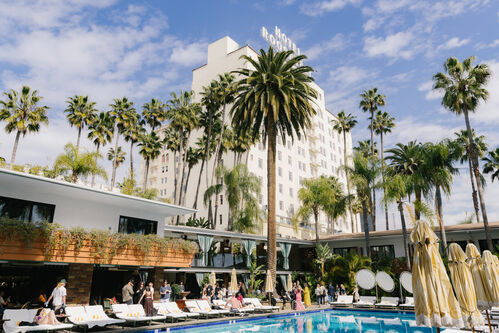
Indeed, on February 19th, at 11 a.m., the fair’s seventh edition attracted an eager crowd to the Hollywood Roosevelt Hotel for its VIP day. This year’s edition of the fair hosts more than 60 exhibitors within the poolside cabanas surrounding the hotel’s iconic David Hockney–designed pool and the suites on the 11th and 12th floors. And, while the hotel felt less crowded than last year’s iteration, a steady stream of fairgoers continued to meander in to enjoy cocktails by the pool and browse the galleries throughout the day. Among the celebrity attendees were generational heartthrobs—from pop star Troye Sivan to the timeless Henry Winkler (Fonzie from Happy Days)—who made their way through the booths. Julia Fox was also spotted engaging with several gallerists around the cabanas.

The fair’s emphasis on its locality is immediately apparent as visitors enter the lobby of the hotel, where LA AYUDA Network is presenting “Foundations.” The benefit exhibition features more than 100 artist-made stones and ephemera meant to symbolize local community. These stones are priced on a sliding scale between $125 and $500, and all proceeds will be donated to underresourced communities.

Throughout the fair’s VIP day, presentations from Los Angeles–based galleries were among the busiest booths, with gallerists keen to emphasize the importance of the fair to the city’s art ecosystem.

Among the galleries circling the pool is local stalwart Nicodim. The poolside cabana features a “smorgasbord of our best and brightest,” according to the gallery’s partner Ben Lee Ritchie Handler. At the center of the booth is Isabelle Albuquerque’s sun flower (2024), a delicate bronze flower sprouted from a piece of Pacific live oak. Scattered throughout the booth are humanoid stoneware sculptures by L.A.-based artist Stanley Edmondson. Works in the booth are priced between $5,000 and $45,000.

Sales took off quickly for the gallery. “The vibes are off the charts. Business is great,” said Handler. “We actually had three collectors that we told no holds [on a particular piece by Devin B. Johnson]. We had three people running to the booth at 11 a.m. to come in, and the people that didn’t get the painting they wanted got other things.” Johnson’s sought-after piece, A Curious Shade Fell Upon Thy Brother’s Countenance (2025), sparked a rush of eager collectors, with the first to arrive securing it.

Handler emphasized the importance of recognizing Los Angeles’s resolve as an arts community. “It’s really easy to get jaded in this business, but when something like that happens, it reminds you why we do it,” said Handler. “Everybody that comes here has realized that we don’t need charity. We need energy, and people have really brought that.”

Elsewhere along the pool, West Hollywood’s M+B introduced a group of emerging artists from Brazil participating in the gallery’s residency program, Domo Damo. This initiative aligns with an upcoming exhibition opening on Friday, which features both historical and contemporary artists. The showcase includes works by Gustavo Caboco, Lu Ferreira, Lucas Almeida, Luciano Maia, Mateus Moreira, and Thiago Molon, with prices ranging from $6,000 to $30,000. Above all, M+B founder Benjamin Trigano emphasized the fair’s significance to the city: “It was much needed [after] what’s happened. We needed this energy to come back because everybody was so devastated, and this is a little hope for us,” he said.

Up the elevators, local tastemaker Megan Mulrooney is showcasing work by 70-year-old Los Angeles artist Nick Taggart. The gallerist, who opened her eponymous space last year, underscored how proud she is of the city’s collective efforts to support artists impacted by recent fires.

“Even if we were worried about it being light foot traffic, it felt important to be part of it and show that in solidarity, that we’re still here,” said Mulrooney. “Art unites. It brings people together. It’s a common place to discuss feelings and thoughts and also to lean in and talk about grief.”

Larger Than Life, 1987
Nick Taggart

Megan Mulrooney

Taggart, whose commercial work was mainly conceived in the 1970s and ’80s, is widely influential while being unrecognized by the art world at large. Despite this, he has maintained an impressive archive of his work, providing a vital link to the city’s past. “The nostalgia that people feel while looking at this work is really because this is how they understand Los Angeles without even knowing it,” said Mulrooney, noting that much of Taggart’s career had been spent making similar drawings as “cultural exports” for various magazines and publications. His works on paper, priced between $4,500 and $10,500, are shown along with a standout painting of a dog in a living room—Larger Than Life (1987), valued at $25,000. These works are a snapshot of the city’s history, giving fairgoers a chance to tap into the cultural core of Los Angeles.

“The community is unlike any other,” said Mulrooney. “They’ve come together, raised millions of dollars for those affected in the fire through arts initiatives, through not only the Getty, but all of the museums, [which] have banded together and thought about how they can support artists who have lost not only their houses but their livelihoods.”

As a visitor, Miami-based Nina Johnson made an effort to understand what the local community needed. “It’s always hard as an outsider, coming into a city, but we spoke with a lot of our colleagues that have galleries here and other artists that are in L.A., and the feeling was ‘We want people here. This is the moment to come and rally,’” said founder Nina Johnson.
The gallery staged a group presentation in a poolside cabana featuring the works of L.A.-based artist Tara Walters, who lost her home in the fires. A standout is Blue (For Jack Bendes) (2025), which depicts a giant blue dolphin jumping above the ocean. Walters is known for her process-driven approach: She often pours ocean water over acrylic-painted canvases, allowing the drying patterns to shape her imagery.

The gallery is also showing several sculptural works made with denim jeans by Christy Gast and giant stoneware vessels by L.A.-based artist Jasmine Little. New York–based artist Madeline Donahue also provided ceramic vases, actively decorating the cabana. Each vase is priced at $1,000, and prices for works in the gallery’s booth stretch to $30,000.

After speaking with galleries and artists in Los Angeles, Portland-based ILY2 took a similar attitude and decided to rethink its group presentation at the fair. Instead of its original proposal of rostered artists, the gallery curated a group show of L.A.-based artists Leena Similu, Amanda Ross-Ho, Beatrix Fowler, and Isabel Yellin, with works priced between $4,500 and $30,000.

“We really wanted to talk to the local community, and check out with artists and and see how everyone here felt,” said gallery director Rosie Motley. “The feedback [from Los Angeles] was emphatically like, ‘We want people to show up!’”

In the suite’s smaller room, the gallery also wanted to curate a selection of editions, design objects, and books to “emphasize accessibility” in an art fair setting. Standout pieces include prints by Eve Fowler and stoneware by Martie Kilmer. These works, from a selection of gallery artists, are priced under $600 apiece.

As the day unfolded, fair co-founder Morán was seen holding court both around the hotel and inside his gallery’s presentation as streams of VIPs continued to enter. Morán Morán is presenting the work of 12 artists, including Eve Fowler, Becky Kolsrud, David Benjamin Sherry, Cauleen Smith, and Oscar Tuazon.

Overcoming numerous hurdles, from recent events to instances such as the COVID-19 pandemic, have helped to shape Felix into what it is today, he reflected. “I never thought I’d see seven, and I could totally see 10,” he told Artsy. “It’s become a discovery fair for me at this point. You’re here to discover.”
News Feed Articles

6 Artists to Follow if You Like Robert Rauschenberg

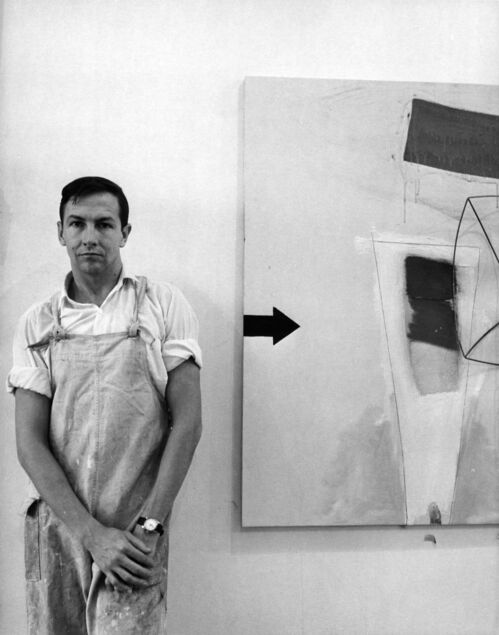
Robert Rauschenberg, born 100 years ago this year, was one of the 20th century’s most influential artists who, over the course of a 60-year career, left his distinctive mark on many different media, including painting, sculpture, printmaking, photography, and performance. Not only an important precursor of Pop Art, he has been described as “a forerunner of essentially every post-war movement since Abstract Expressionism.”

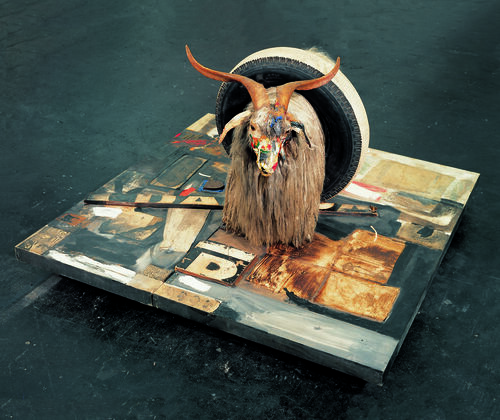
Rauschenberg is best known for his “Combines” (1954–64), which incorporated elements of both painting and sculpture into a single work. These pivotal experiments, made using mundane found objects such as newspaper clippings, photographs, bedspreads, cardboard, fabric, and rubber tires, are some of the finest artworks ever to explore the boundaries between art, popular culture, and the everyday world.
In 2025, several major exhibitions will explore different aspects of his legacy. For example, Hong Kong’s M+ Museum will take a comprehensive look at Rauschenberg’s longstanding engagement with Asian culture, while his collaborations with fellow artists will be examined in “Five Friends: John Cage, Merce Cunningham, Jasper Johns, Robert Rauschenberg, Cy Twombly” at the Museum Brandhost in Munich. Finally, solo shows at Gladstone Gallery in New York and Thaddaeus Ropac in Paris will pay homage to his enduring importance (in May and October, respectively). Meanwhile, the 2025 edition of miart, Milan’s international art fair, will adopt his life and works as its curatorial theme.

Also a philanthropist and passionate advocate for social and political change, Rauschenberg established the Rauschenberg Foundation in 1990 to support artists and institutions who share his inclusive, collaborative, and multidisciplinary approach.

And his influence continues to be felt today. As Julia Blaut, the Rauschenberg Foundation’s senior director of curatorial affairs, pointed out, “In so many instances, artists today acknowledge his precedence, have run with his example, and have extended his ideas in completely original and unexpected directions.…He always was and remains an artist’s artist.”

So, to help celebrate what would have been Rauschenberg’s 100th birthday, here’s a list of six contemporary artists who share his pioneering spirit and innovative use of materials.

Mark Bradford

B. 1961, Los Angeles. Lives and works in Los Angeles.

When the Hilltop Gets Heavy, 2016
Mark Bradford

Hauser & Wirth

Using found objects and everyday items such as maps, billboards, comic books, and movie posters, Mark Bradford creates monumental abstract paintings that are both formally complex and politically charged. First layering paper, rope, and paint, Bradford then “excavates” the surfaces of his canvases using tools to reveal intersections of meaning between the different materials.

Directly inspired by Rauschenberg’s “passionate, multifaceted, and plural” approach, as well as his activism, Bradford’s intricate and ambitious works are deeply rooted in sociopolitical issues, addressing the exploitation of marginalized communities while also exploring the relationship between high and low culture.

Bradford received his BFA and MFA from the California Institute of the Arts (CalArts) in 1995 and 1997, respectively. He has exhibited widely at some of the most prestigious locations in the world and represented the U.S. at the Venice Biennale in 2017. He has received numerous awards and honors, including a 2009 MacArthur Fellowship and an appointment to the American Academy of Arts and Sciences in 2019.

Gedi Sibony

B. 1973, New York. Lives and works in Brooklyn.

The Beginning is Near, 2008
Gedi Sibony

MEYER*KAINER

Half Loaf, 2014
Gedi Sibony

Rema Hort Mann Foundation Benefit Auction

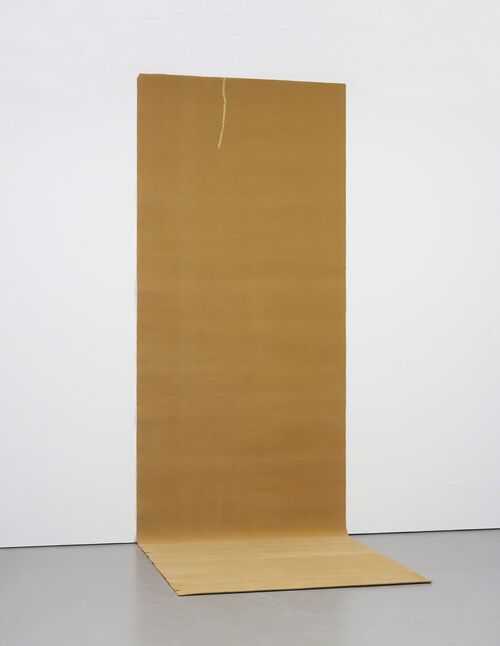
The work of Brooklyn-based artist Gedi Sibony occupies its own unique space somewhere between sculpture, assemblage, and installation. Using discarded quotidian objects such as cardboard, plastic sheeting, carpet, and wood, he creates fragile works of poetic minimalism that reveal the expressive potential of the otherwise mundane materials he has rescued from oblivion.

Sibony has cited Rauschenberg as a direct influence, describing the practice of selective appropriation in his “Combines” as “an enactment by the artist, accomplished through total immersion,” which is mirrored in his own work.

Sibony graduated with an MFA from Columbia University in 2000, and his work has been exhibited in numerous group and solo shows. His work is held in the collections of the Museum of Modern Art and the Whitney Museum of American Art in New York, as well as the San Francisco Museum of Modern Art, among many other institutions.

Song Dong

B. 1966, Beijing. Lives and works in Beijing.

Doing Nothing Doing Debris 007, 2014
Song Dong

Pace Gallery

Reflecting his experience growing up in the rapidly changing culture and society of contemporary China, Song Dong uses everyday objects and ephemera to explore themes of impermanence, self-expression, and the transience of human endeavors.

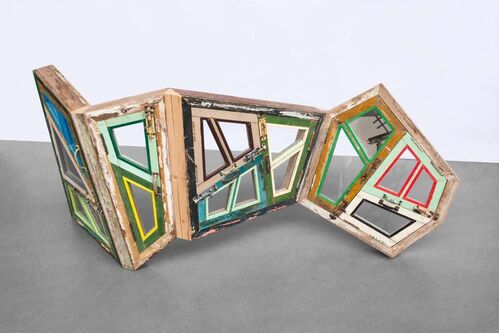
The artist has acknowledged Rauschenberg’s pivotal 1985 exhibition in Beijing (the first solo show in China by a contemporary Western artist since the Cultural Revolution) as a major influence. Impressed by the American artist’s playful transformation of ephemeral objects into poetic works layered with meaning and metaphor, Song Dong would then abandon painting in favor of sculpture, installation, video, and performance. These have included his beguiling assemblages of old wooden doors, windows, and mirrors, such as Da Cheng Ruo Que Φ185 No.03 (2020–23).

Song studied fine arts at Beijing’s Capital Normal University, graduating in 1989. He has exhibited widely since the early 1990s, including major solo shows at the Barbican Centre in London, the Museum of Modern Art in New York, and the Groninger Museum in the Netherlands.

Jessica Stockholder

B. 1959, Seattle. Lives and works in Nanaimo, Canada.

Untitled, 2007
Jessica Stockholder

Galerie nächst St. Stephan Rosemarie Schwarzwälder

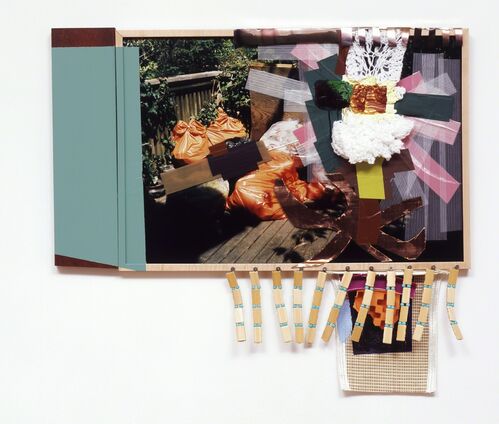
Regarded as one of the most important sculptors of her generation, Jessica Stockholder uses store-bought and mass-produced objects to create vibrantly colored large-scale sculptures and installations, which have been described as “paintings in space.” Meticulously arranged, these three-dimensional compositions explore the pictorial potential of objects and surfaces, along with the physical spaces that surround them.

Her bold combination of painting and sculpture has led to frequent comparisons with Rauschenberg, and she has acknowledged his formative influence. Describing the impact of his “Combines,” especially Monogram (1955–59), she recently observed that his “searching, dabbing gestures of idiosyncratic world-making…opened a door” for her own work.

Stockholder received her MFA in painting and sculpture from Yale University in 1985. Her work is held in many international collections, including the Whitney Museum of American Art, the British Museum in London, and the Stedelijk Museum in Amsterdam.

Rachel Harrison

B. 1966, New York. Lives and works in New York.

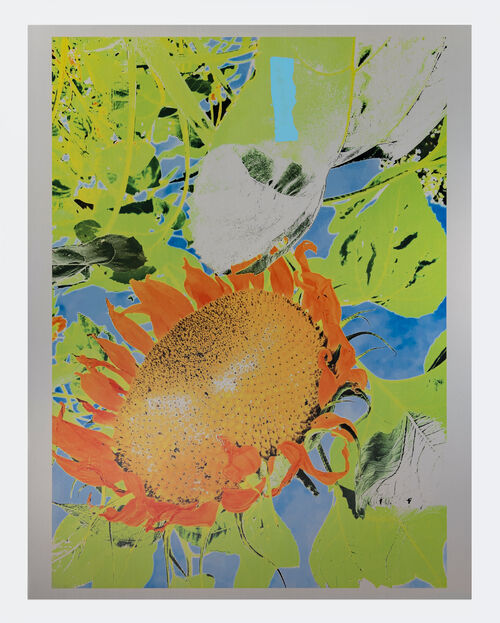
Sunflowers, 2021
Rachel Harrison

MEYER*KAINER

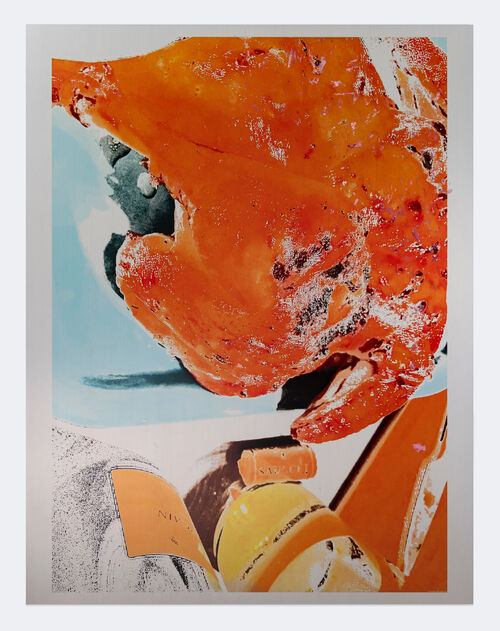
Chicken, 2021
Rachel Harrison

MEYER*KAINER

Flamboyant, irreverent, and peppered with both pop cultural and high-art references, the sculptures of Rachel Harrison juxtapose abstract forms with everyday consumer products, celebrity imagery, and brightly painted household tools. Often displayed in multimedia installations alongside her photographs and drawings, her sculpture works create a wryly humorous dialogue between art history, contemporary culture, and politics.

Her multifaceted approach and playful appropriation of the expendable detritus of American consumerism and popular media bears obvious parallels with the work of Rauschenberg, and in 2015 the Cleveland Museum of Art exhibited their work together, inviting a direct comparison between the two.

Harrison received a BA in fine art from Wesleyan University in 1989 and had her first solo show at New York’s Arena Gallery in 1996. Today her work can be found in numerous major collections, including the Museum of Modern Art in New York, the Tate in London, and the Hirshhorn Museum and Sculpture Garden in Washington, D.C.

Ebony G. Patterson

B. 1981, Kingston, Jamaica. Lives and works in Kingston and Chicago.

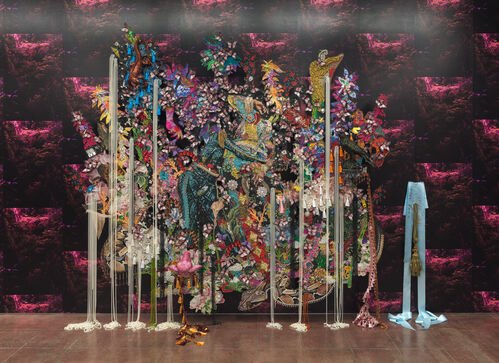
…in the lament…there is a nest…a bursting a…nourishing, 2021-2022
Ebony G. Patterson

Hales

Spanning diverse media—including tapestry, drawing, video, sculpture, photography, and installation—the work of Ebony G. Patterson is both enchanting and colorful. However, its surface beauty and frequent references to art history, popular culture, and religious imagery mask darker themes including postcolonial violence, gender inequality, and the objectification of the female body.

Patterson’s densely layered tapestries, heavily adorned with sequins, glitter, fabric, toys, costume jewelry, and fake flowers, have a three-dimensional, almost sculptural quality that clearly recalls Rauschenberg’s “Combines.” The artist, who was featured in The Artsy Vanguard 2019, has spoken of the influence his monumental fabric collages had on her own work, and in 2017 was an artist in residence at the Rauschenberg Foundation.

Patterson received her MFA in printmaking and drawing from the Sam Fox School of Design and Visual Arts in St. Louis, Missouri, in 2006. She has exhibited internationally and been the recipient of numerous awards, including a 2024 MacArthur Fellowship.

News Feed Articles

Magritte painting, estimated at $7 million–$11 million, to headline Christie’s surrealism sale.

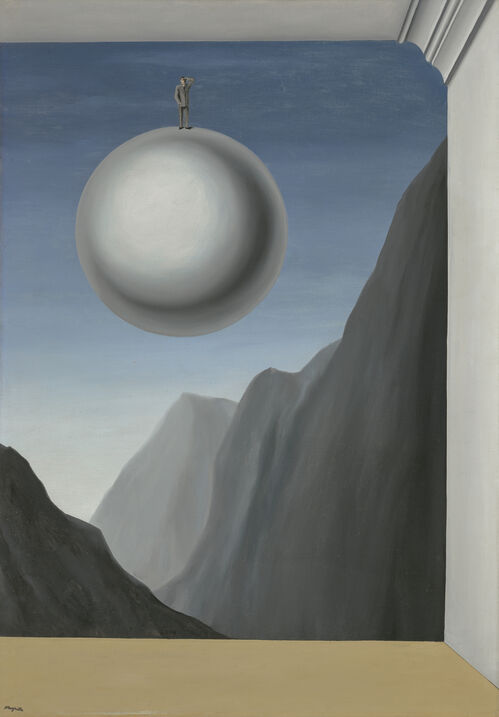
René Magritte’s La reconnaissance infinie (1933) is poised to headline Christie’s “The Art of the Surreal” evening sale on March 5th in London. The painting holds a presale estimate of £6,000,000–£9,000,000 ($7.5 million–$11.3 million), a notable increase from its last auction price of £677,250 ($1.2 million) at Christie’s London in 2004.

La reconnaissance infinie features a variegated orb hovering above a serene mountainous landscape. On top of the orb, a suited figure stands with one hand tucked into his pocket. The scene is framed by a window sill, as if the viewer is observing the orb and tranquil terrain, evocative of the landscape of Magritte’s childhood home in Hainaut, Belgium.

After three years immersed among the Surrealists in Paris, Magritte returned to Brussels in 1930. “It was [in Paris] that his mysterious visual language truly began to solidify, as he set out to challenge and undercut established traditions of representation in painting and forge a distinctive new path within Surrealism,” Christie’s deputy chairman Olivier Camu told Artsy. La reconnaissance infinie features several motifs the artist developed during his time in Paris, particularly the giant orb, which appeared in several paintings from 1928 to 1931.

The Surrealist poet Paul Colinet, a friend of Magritte’s, partly inspired the painting. In 1933, Colinet visited an exhibition of Magritte’s work and subsequently gifted the painter a drawing of a small man floating on an orb through a mountain valley.

“While the composition appears to echo and reflect certain aspects of earlier paintings from the Paris period—particularly the floating, mysterious orb—Magritte explores and expands the poetic potential of his imagery,” Camu said. “Here, the presence of the figure atop the sphere conjures a strange, metaphysical question, prompting the viewer to reconsider their own position within the universe, floating on a globe as it hurtles through space.”

The painting is the latest major work by Magritte to come to auction after two paintings by the artist ranked among the 10 most expensive auction lots of 2024. His painting L’empire des lumières (1954) was the most expensive auction lot of last year and established a new record for the artist when it sold for $121.16 million at Christie’s New York in November.

“As a true conceptual poet, his ideas resonate universally, making his work highly desirable,” Camu said. “Demand for Magritte continues to grow, driving prices steadily upward, with collectors showing interest in all periods of his oeuvre.”

“The Art of the Surreal” will also feature five additional paintings by Magritte:

  • La lumière du pôle (1926-27), estimated at £4.5 million–£6.5 million ($5.6 million–$8.2 million).
  • Le faux miroir (1952), estimated at £1.5 million–£2.5 million ($1.89 million–$3.1 million).
  • La femme du maçon (1958), estimated at £1.6 million–£2.4 million ($2 million–$3.02 million).
  • L’école buissonnière (1946), estimated at £500,000–£800,000 ($630,000–$1 million).
  • Le stropiat (1948), estimated at £1 million–£1.5 million ($1.2 million–$1.89 million).
News Feed Articles

Dealer Michael Kohn Reflects on Four Decades in the Los Angeles Art Scene

When Michael Kohn opened his eponymous gallery in West Hollywood four decades ago, his choice of location seemed far from a plausible business plan at the time. With its breezier pace and dominance of the entertainment industry, the City of Angels did not resonate with the avant-garde grunge of the downtown New York scene where the dealer cut his teeth.

This spring, however, the veteran dealer is celebrating the 40th anniversary of Michael Kohn Gallery during the city’s art week, headlined by Frieze L.A. and featuring other fairs including Felix Art Fair and Post-Fair. The annual gathering’s return, however, comes in the aftermath of the immensely destructive wildfires across Los Angeles County that have destroyed the homes and studios of hundreds of artists and damaged countless artworks. The wildfires have shed a somber light on an otherwise vibrant art world tradition. “The first few weeks of the fires were spent in shock,” Kohn told Artsy. “But freezing completely for who knows how long doesn’t really help the city—we need to try to go back to normal so that businesses can survive.”

While the dealer is eschewing any art fair participation throughout the week, he will celebrate the gallery’s landmark with a group show that features a plethora of periods that it has shown throughout its history. Paul Cézanne, Carl Andre, Chiffon Thomas, Richard Pettibone, Lita Albuquerque, Eddie Martinez, Pablo Picasso, Alex Katz, Donald Judd, Gonzalo Lebrija, and Ilana Savdie are among the numerous featured names.

Navigating through the many facets of L.A.’s art scene has taught Kohn a thing or two about surviving twists and turns. The City of Angels native was an art history student at UCLA when he shared an apartment with a young Kenny Scharf, who would later up sticks to the East Coast. “I was confused when Kenny shared his New York plan because we were having fun in California,” Kohn recalled.

However, it was none other than Scharf who introduced the future dealer to the boiling creativity of New York’s downtown. Kohn would later make the move himself, and formative moments included visiting Jean-Michel Basquiat’s basement studio where the rising star worked on six paintings at a time. He also entered the circuit of leading dealers like Angela Westwater. The perfect alchemy of youthful ambition and being at the right place at the right time led Kohn to editorial positions at Flash Art and the influential now-bygone Arts Magazine.

Untitled (Dollar Bill), 1962
Andy Warhol

Michael Kohn Gallery

But Kohn knew early on that he had to carve his own footing. The avid student worked on his thesis at NYU while interning at the Guggenheim, all while opening his first gallery on East 10th Street. Kohn’s first eponymous endeavor coincided with the neighborhood’s short-lived era of experimental commercial spaces, such as Nature Morte, Gracie Mansion, Piezo Electric, Fun Gallery, and P·P·O·W. Kohn’s first show reflected the most impactful tremor on the era’s art scene—the AIDS pandemic—through the work of artists such as gustavo ojeda, Dana Garrett, and Arch Connolly, who all eventually passed away from AIDS-related illnesses.

Witnessing this gruesome sweeping of the art scene, which Kohn recalls as a “terrible terrible moment in the community,” the urge to return to his hometown felt stronger. “My mom was born in Los Angeles as well as myself and all my siblings, so I just wanted to be back,” he said. In 1985, he moved to the West Coast and opened a space in West Hollywood. The young dealer’s priceless possession, however, was his New York connections that he could bring to a metropole where the art market was incredibly nascent. To maintain what he calls the “New York cachet,” Kohn constantly traveled back to the East Coast, so much so that most friends didn’t realize he had moved out.

Desire And Memory, A Poem For Ana Mendieta, 2024
Lita Albuquerque

Michael Kohn Gallery

The title of the gallery’s inaugural show fittingly embodied Kohn’s growing expertise—“New York’s Finest”—and featured a who’s who checklist of downtown artists, with Basquiat, Scharf, and Andy Warhol among them. The storefront where he couldn’t afford to change the black carpeted floor saw a slice of East Village vigor on the opposite side of the country.

But bringing together New York’s blockbuster names under a roof thousands of miles away proposed unprecedented challenges. “I didn’t realize we didn’t have the ease of communication,” said Kohn. “If a client on the East Coast wanted to see a little Warhol print, I would develop its four-by-five transparency, frame it, and pay the equivalent of $50 today for shipping, which was too high for a small gallery.” L.A.’s slim number of local contemporary art collectors at the time—which Kohn jokingly remembers as just “five”—didn’t seem like enough to sustain a commercial space at the time.

His academic background in art history, however, came in handy in establishing a strong resale market of historical and heavyweight 20th-century names. Works by the likes of Picasso, Gerhard Richter, Marcel Duchamp, and Warhol were among them. Another effective strategy Kohn found was to convince a few major collectors to put money upfront towards a show that would encourage established artists to provide work for ambitious solos. The model helped him to organize shows with Keith Haring, Alex Katz, James Rosenquist, and his old friend Scharf.

As Kohn began to carve out a niche on the West Coast, local connections began to find him through a slower process of research and chance. The gallery’s first four years primarily promoted New York artists to the City of Angels, and the dealer was initially hesitant about the highly conceptual angle of local powerhouse institutions such as CalArts, where numerous household names such as Mike Kelley, Carrie Mae Weems, and Jim Shaw studied. “I was friendly with many of its graduates, but I didn’t show them,” he said. However, his taste “developed” over time.

One of the most definitive outcomes of the dealer’s broadened palette was a visit to Californian video art pioneer Bruce Conner’s studio in 1988. The encounter led to Conner becoming Kohn’s first Californian artist signing, whom he described as “one of the great art filmmakers of the 20th century.” The dealer has since been supporting the restoration of the late artist’s films and producing the works in editions of six to place them in important international collections. The project’s most recent bearing is a seven-minute black-and-white film titled THE WHITE ROSE (1967), which is a crown jewel of the gallery’s anniversary show.

Unquenchable Laughter, Inescapable Desert, 2023
Li Hei Di

Michael Kohn Gallery

At the Same Time, 2023
Sophia Narrett

Michael Kohn Gallery

Kohn’s formula for longevity and relevance has been his adaptation to market fluctuations by bridging established industry fixtures with fresh talent. Translating his critical lens and New York savoir to a growingly engaged audience, he has trusted his eye for when to take a chance, whether reintroducing veterans such as Conner and Wallace Berman or giving a platform to newcomers like Li Hei Di, Sophia Narrett, and Jinbin Chen Tianyi. Today, he is positive about the art ecosystem in his hometown. “Now we have a lot more collectors coming in,” he said, noting that “the world has gotten much smaller and the communication has become more instantaneous,” unlike his early years.

For Kohn, learning the ropes of the art business has been a decades-long challenge, one that has long proven its fruits. “It took me a long time to learn how to sell art,” he reflected. The early “guilt” of selling what he liked to read about in books has since transformed into confidence in helping establish careers. Kohn believes in the balance between “representing an artist’s intellectual aspect and knowing when to stop talking.”

The dealer feels little regret about not expanding his enterprise or opening outposts in other cities like most of his peers. “The business would be bigger but perhaps would come at the cost of my personal life,” Kohn said. “I did the best I could do, which also includes owning my gallery’s space.”

Design Iconics News Feed Articles product design

Charles and Ray Eames | Love and Modern Design

Charles and Ray Eames are among the most influential designers of the 20th century, heralding a genuine revolution in architecture and product design. From their pioneering work with molded plywood to their iconic plastic seating and the celebrated Eames Lounge Chair, their contributions reshaped the modern aesthetic and influenced generations of creatives worldwide. Far beyond…

The post Charles and Ray Eames | Love and Modern Design appeared first on Hue & Eye.