Art Market Trends 2025

Welcome to Art Market Trends, Artsy’s new research-driven report on the key topics shaping the art industry and collecting in 2025.
Rather than looking into a single slice of the art market at a time, as we have done in the past, we constructed this report from two concurrent surveys—one sent to galleries and another sent to collectors—which together yielded insights from over 1,600 respondents from across more than 60 countries.
The purpose of this report is to bridge these two pillars of the art market to generate a set of findings that holistically represent the current state of the market. Through our findings, we’re able to answer questions not just about galleries and collectors, but also about how they interact, such as whether the segments of the market that are most important to galleries are also the most desirable for collectors? Are digital-native collectors seeking out galleries with robust online sales operations?
We focus on topics including the need for increased transparency in the art market, the categories of art that are viewed as the most important commercially, art pricing trends, sales strategies, and the role of online channels.
What we have found overall is a nuanced picture of how collectors and galleries view each other. One key finding offers important context: Just 17% of collectors believe that the art market caters “very well” to them. Most collectors, we found, think art collecting would be easier with more transparent artwork pricing and information; a lack of transparency is viewed as a primary barrier to buying art online. But this sentiment is only partially matched by the galleries we surveyed: While most acknowledge that their collectors care about transparency, a minority say they took steps to improve it last year.
We also found that, in a challenging economic environment, galleries are turning to digital channels to reach new collectors more effectively. More than half of galleries said that they are expanding their online channels in response to the challenges facing their businesses. Meanwhile, collectors use online platforms like Artsy and Instagram to discover new artists. This trend is particularly notable among young collectors, who most galleries are prioritizing in their outreach efforts.
Below, we share a summary of the findings. To read the report in full, click here to download the PDF.
1. 43% of galleries plan to focus more on online sales
With online channels now an established pillar of the art market, galleries are looking to invest more in the digital space to meet growing collector demand and attract new collectors.
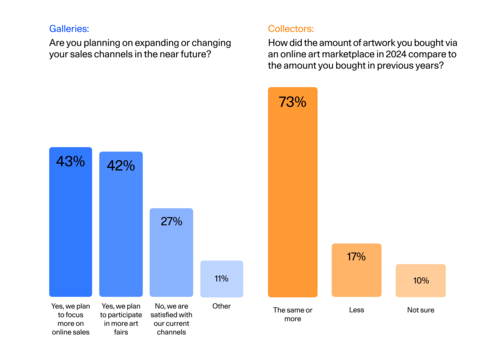
About 43% of galleries said they plan to focus more on online sales in the near future. When asked what new engagement strategies they are planning to implement in 2025, most (55%) said they are looking to create more online content, which can range from social media videos to online-only gallery shows. This response outranked hosting more in-person events (45%) and collaborating with other galleries or institutions (42%).
Collectors are keeping pace, continuing to buy art online. Some 59% said they purchased art online in 2024, with 73% of those saying that they purchased as much or more art online in 2024 compared to 2023.
Galleries are also using online channels to adapt to a challenging macroeconomic environment. Of the galleries surveyed, 75% selected economic uncertainty as one of the biggest challenges they face, followed by changing collector behavior or lack of demand (60%). To address these challenges, 57% of respondents said they are expanding their online presence.
2. 30% of art collectors say they’re being more selective
Lagging economic growth, geopolitical tensions, and persistently high interest rates continue to take a toll on the art industry. It’s unsurprising, then, to see this sentiment mirrored in our surveys of both galleries and collectors.
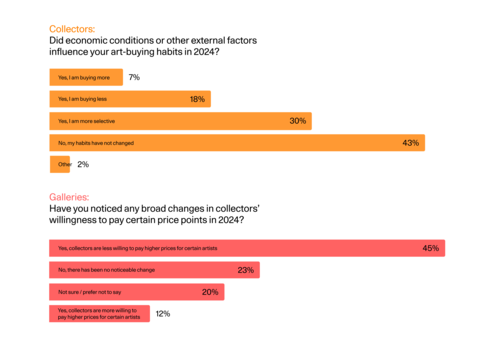
When asked how economic and other external factors influenced their art-buying habits in 2024, some 30% of collectors said they became more selective in their art-buying habits, and just 7% said they bought more compared to 2023. Indeed, 75% of galleries identified economic uncertainty as one of their biggest challenges, followed by changing collector behavior or lack of collector demand (60%). Economic difficulties are expected to persist: The highest proportion of galleries (48%) anticipate these external factors will continue to affect the art market “significantly” in the near future, while 45% said they will have “somewhat” of a bearing.
Similarly, 45% of galleries noted that collectors were less willing to pay higher prices for work by certain artists in 2024, while the majority of collectors (73%) selected high prices as a challenge they faced when buying art. Some 78% of collectors also said they had hesitated to buy an artwork because it was too expensive for their personal budget. Meanwhile, 52% said that they hesitated because they viewed the artwork as overpriced, and 32% said they hesitated because they were unsure if it was worth the price.
3. 69% of art collectors say a lack of transparency has kept them from buying art
Transparency—in terms of artwork prices, provenance, or additional information—remains a key factor in art collectors’ purchasing decisions. Our surveys show that galleries have recognized this.
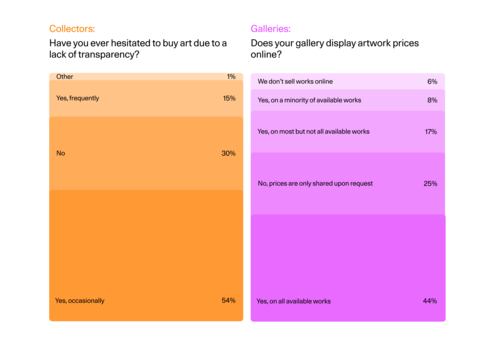
Some 69% of art collectors we surveyed said they’d hesitated to buy art due to a lack of transparency. Meanwhile, only 5% of collectors we surveyed said that the art market is “completely” transparent when it comes to factors such as history, provenance, and availability of artwork prices. The need for more information about artworks emerged as a recurring theme among collectors. When asked what the art market and galleries could do to make art collecting easier, 60% said greater transparency in artwork pricing.
This is particularly relevant for online sales channels. When asked about the biggest hindrances to buying art online, the highest proportion of respondents who had purchased art online in 2024 selected insufficient information about the work (48%) and lack of visible price (43%).
Fortunately, many galleries are recognizing a need for greater transparency. Some 62% said they felt transparency was “very” important to their collectors, while 27% said it was “somewhat” important, 8% said “not very” important, and 1% said it’s not important “at all.” In fact, there is a clear link between transparency and sales: Artworks with visible pricing on Artsy, for instance, are about six times more likely to sell than those without.
But are galleries doing enough to increase transparency? Not quite. Fewer than half of galleries (44%) surveyed said they display artwork prices online for all available works, while a significant 25% said they only share prices on request.
4. 72% of art collectors are drawn to emerging art
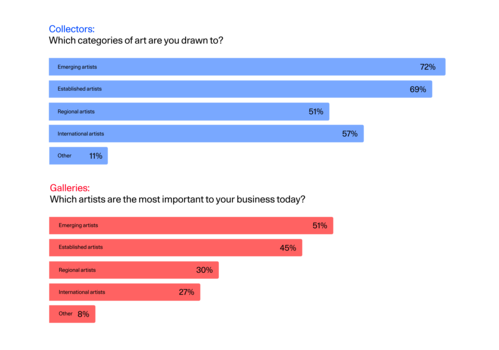
Emerging artists—categorized as those in the earlier stages of their professional art careers—form the bedrock of both the buying habits of art collectors and the business strategies of the galleries that we surveyed.
When asked about the categories of artists they were drawn to, 72% of collectors selected emerging artists, while 69% selected established artists—defined as those that have achieved international recognition. Galleries echoed this sentiment: 51% said that emerging artists are among the two most important categories for their business, followed by established artists (45%).
Collectors are drawn to emerging artists, in part, because their early-career status often means lower artwork prices. When asked for the typical price range they consider for artworks, the highest percentage of collectors (61%) said they consider artworks priced under $5,000, followed by 38% who said they considered artworks priced between $5,000–$9,999 (respondents could select up to two price ranges).
5. Only 17% of collectors believe the art market meets their needs
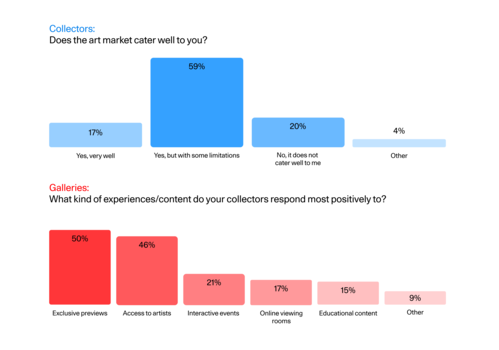
Accessibility has become a central focus in the art market, as sellers seek to attract and retain new collectors. However, our findings suggest that the industry still falls short of meeting buyers’ expectations. Just 17% of collectors we surveyed said that the art market caters “very well” to them, and only 18% believe galleries are doing enough to educate and engage new collectors.
Still, our survey reveals broad alignment between how collectors and galleries value their interactions with one another. When asked what kinds of engagement they value from galleries, most collectors (62%) said exclusive previews of new works, followed by behind-the-scenes access to artists (54%). Galleries echoed this, with 50% citing exclusive previews and 46% citing behind-the-scenes artist access as the content that resonates most with collectors.
However, a notable disconnect emerged around educating collectors. Some 46% of collectors said they value educational content about art history or techniques from galleries. Yet, only 15% of galleries identified educational content as something collectors respond to positively.
Methodology
Art Market Trends 2025 was developed through two online surveys that ran concurrently from February to March 2025.
The gallery survey received responses from 384 gallery professionals and dealers who are both partners and non-partners of Artsy. The survey received responses from over 60 countries. The majority of participants (40%) are based in the U.S., followed by the U.K. (7%).
The collector survey received responses from 1,236 collectors based in more than 60 countries. The majority of participants (57%) are based in the U.S., followed by the U.K. (6%).
Thank you
This report would not have been possible without the collectors, gallerists, art dealers, and other gallery professionals who took the time to respond to our survey. We would like to express our gratitude.
Galleries interested in joining Artsy may visit our gallery partnerships page.