News Feed Articles

Tenant of Culture Skewers Fast Fashion Through Sculpture

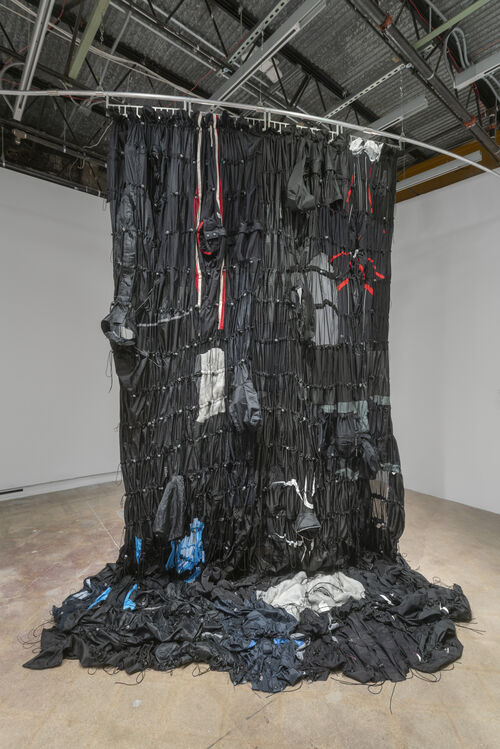
In the mysterious and fragmented world of clothing production, “It’s really difficult to track where something is made, how it’s produced, and under which conditions,” said the Amsterdam-based artist Hendrickje Schimmel. Operating under the name Tenant of Culture, she essentially runs the production process in reverse, taking secondhand garments nearing the end of their life cycles and summarily “unmaking” them. Breaking down eBay or thrift store finds, she told Artsy, she examines their individual parts for clues: “what type of glue is used, the intentions of the designer, how long they’re supposed to last.” From there, the artist reassembles the scraps according to her own formal and conceptual logic, mixing the materials and techniques of disparate eras, functions, and styles.

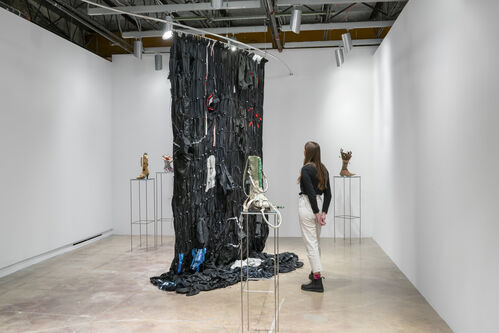
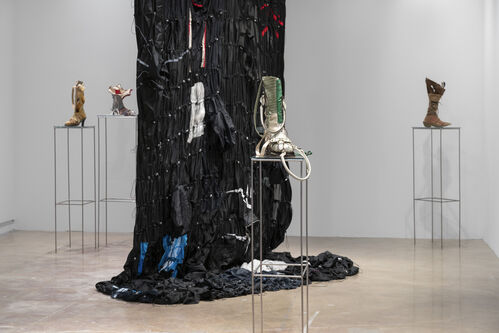
The resulting works, on view now at her two concurrent, debut U.S. solo shows, offer a critique of industrial overconsumption and waste. Some pieces are deconstructed into total abstractions, while others remain legible as clothing—albeit freakishly altered and radically reimagined.

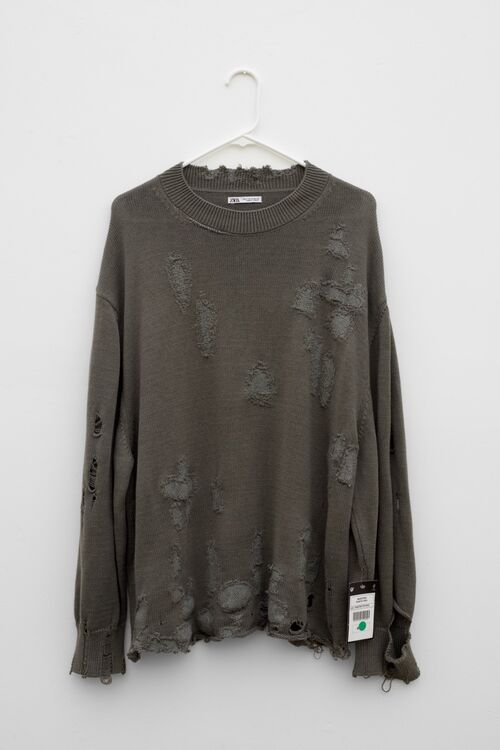
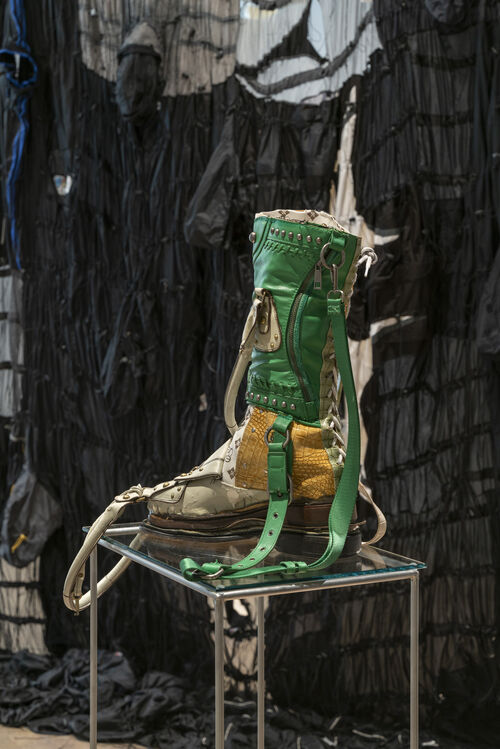
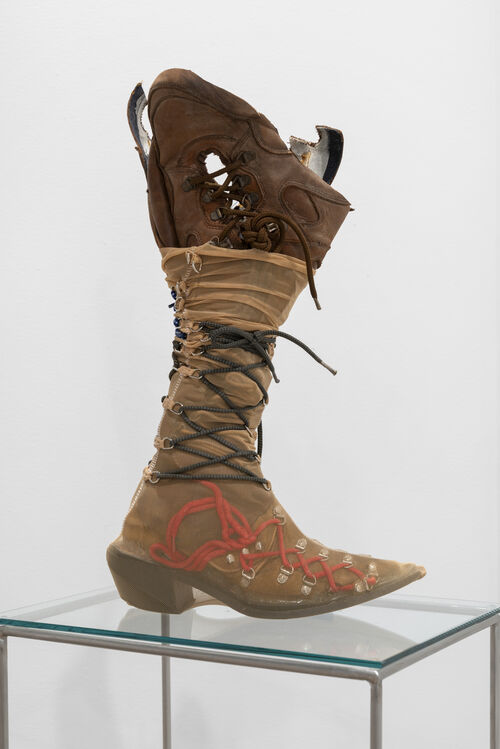
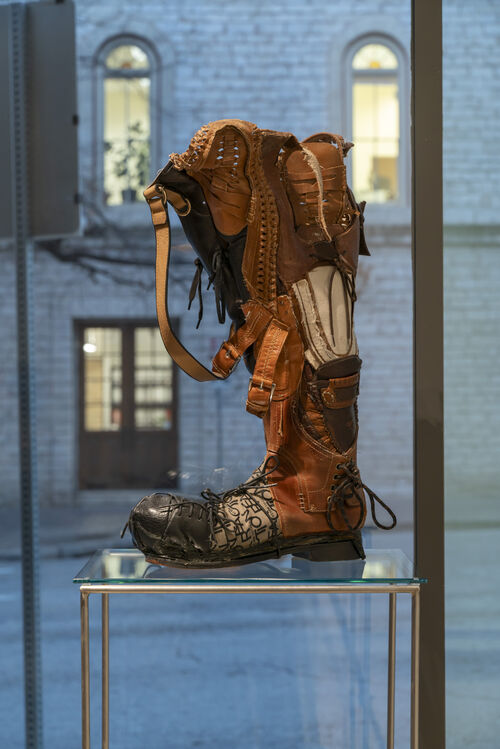
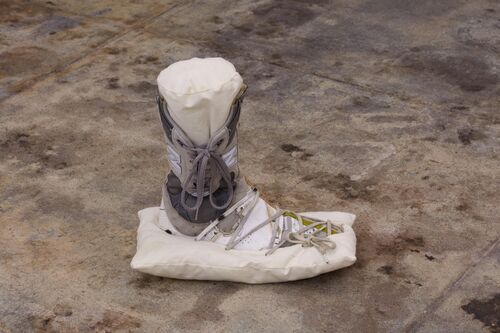
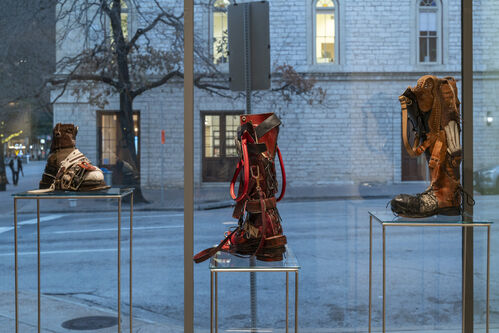
In her conceptual practice, Tenant of Culture is about extending fashion’s notoriously short life cycle, recycling its essentially worthless debris into rigorously constructed sculpture. At “Host: Tenant of Culture” at The Contemporary Austin (on view through August 3rd), Puzzlecut Boot Brown (2021) is a single Frankenstein heel, sutured with purse straps and belt buckles and stacked from the soles of other shoes. “Science and Worms” at Ehrlich Steinberg in Los Angeles (on view through April 5th) features a newer suite of similarly de- and reconstructed footwear, as well as Sabotage in Acrylic (series nr 3) (2025), a piece made from a synthetic Zara sweater that once featured trendy, machine-made holes. Schimmel laboriously repaired them by hand to highlight the difference between “industrial time” versus “craft time”: “Something that was produced in probably less than half an hour took months and months to restore.” Found secondhand with its tag intact, the sweater also embodied fast fashion’s increasingly rapid cycle of replacement; it had been discarded before it was ever worn.

How Tenant of Culture deconstructs the fashion industry
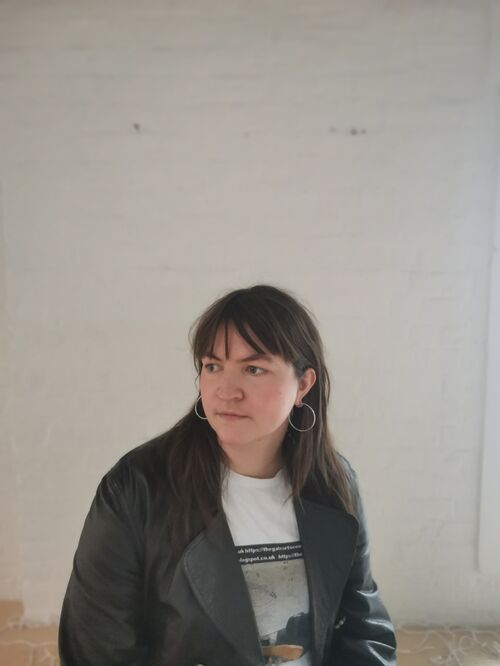
For many years, Schimmel professionally designed outerwear for a mid-sized company, after training in garment-making at London’s Royal College of Art and interning at Alexander McQueen. Ultimately, she explained, she felt alienated by the industry’s secretive production methods and wasteful culture of overconsumption: “Everything that fashion produces is already on its way to be destroyed.”

The artist adopted the name Tenant of Culture as a reference to The Practice of Everyday Life, a 1974 text by the late French scholar Michel de Certeau. He proposed the misuse and reinterpretation of mass-produced goods as a way for consumers to preserve their sense of individuality. The moniker “Tenant” also acknowledges that Schimmel is not permanently tied to any fashion house. “The whole idea of Tenant of Culture is going against the constant material innovation and newness that fashion demands, and seeing how far and how differently you can go with the same materials.”
Textiles in contemporary art are often made or outsourced by artists approaching the medium from an outsider’s perspective, essentially translating the grammar of image making into the language of fiber. By contrast, textile production is Tenant of Culture’s first language; she has the fluency to experiment with the material on a structural level, exploring variations on the traditional stitch the way a painter explores new brushstrokes. “I have my own methods of making that probably don’t at all meet the standards of industrial technique,” Schimmel said. This leaves her free from the practical constraints of making functional clothing.

Paying close attention to trends, the artist incorporates them into different bodies of work, drawing out the historical references frequently forgotten by popular culture. “Eclogues (an apology for actors),” her 2019 show at NıCOLETTı in London, framed the “pastoral nostalgia” surging through high street shops as a strange romanticization of the medieval milkmaid. “Ladder,” her 2023 show at Soft Opening, also in London, was about fashion’s appropriation of distressed fabrics as pure decoration. The 16th-century slashed sleeve trend among European nobility, for example, was inspired by the tattered clothing of soldiers returning from war. Bringing the look into the 21st-century world of e-commerce, Schimmel cut gashes into the packaging of online clothing orders to create “Haul,” a series of strangely beautiful, lumpy soft sculptures of contrasting colors and textures, some adorned with delicately feminine bows.

Artistic preservation and its fashionable decay
Tenant of Culture is represented by Soft Opening in London as well as Galerie Fons Welters in Amsterdam, and has works in the permanent collections of the Het Fries and Stedelijk Museum in the Netherlands. Her crossover from the fashion industry into the art world has provided interesting new angles to mine. During an early gallery show in 2017, viewers described her work as “trendy.” “I didn’t realize that that was an insult,” Schimmel recalled. In contrast to fashion’s ephemerality, she eventually realized that “the status quo within the arts is that something should exceed a certain time period and last for eternity.”

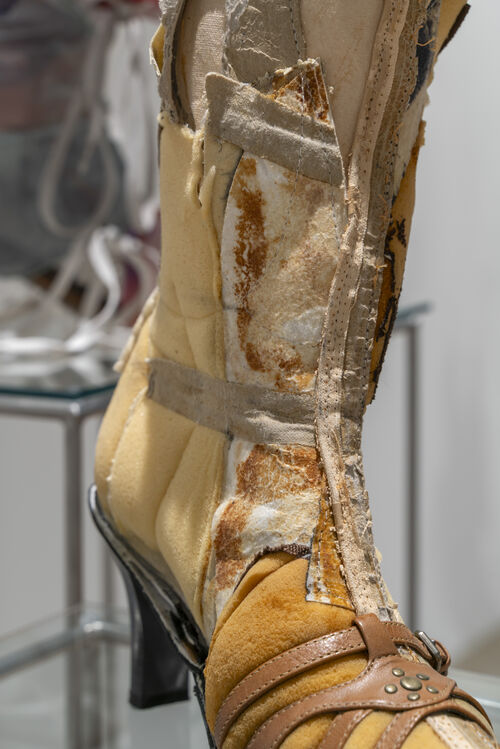
Her current Ehrlich Steinberg show “Science and Worms” merges the contradictions in “fashion time” and “museum time,” abstracting institutional methods of conservation and applying them to shoes that already appear to be falling apart. In her research, Schimmel was surprised to learn “how much effort is put into the preservation of materials that are not meant to be preserved,” she said, as well as some conservators’ desire to maintain the exact point of an object’s existing decomposition. Among her new “Receptacles” sculptures of deconstructed shoes, some are fused at the sole to strange cushions inspired by those in the MFA Boston’s costume archives. Others, fittingly, are held together inside transparent “tombs” of plastic and rubber sleeves. The title refers to Baudrillard’s idea that, in taking cultural artifacts out of their organic context, museum preservation is its own type of unnatural death.

As an ardent critic of the fashion industry, Schimmel is still deeply invested in its artistry and the importance of personal style. She highlighted an important distinction within her practice: “What I am critical of is fashion and its extractive methods as an industrial complex, not fashion as a joyful and important daily practice for so many,” she said. Plus, “I think criticism is much more interesting if you actually really like something.”

News Feed Articles

miart 2025 Strengthens Milan’s Rising Art Capital Status

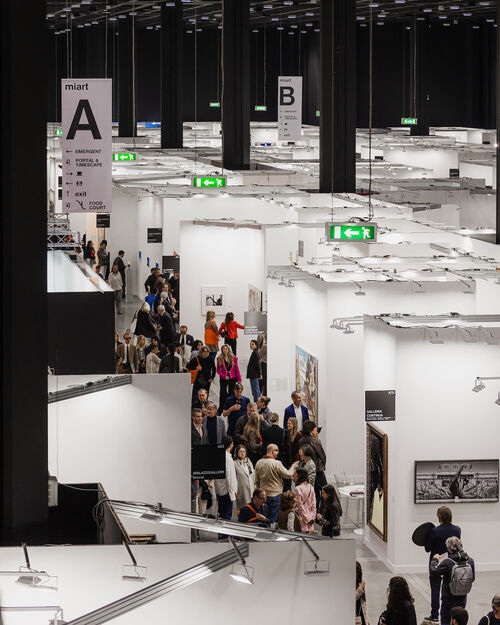
Collaboration is the theme of miart 2025. Taking place from April 4th through 6th, with the VIP preview held on April 3rd at the Allianz MiCo, the fair is now in its 29th edition and brings together 179 galleries from 31 countries and five continents. This year’s fair also comes at a time when the city is looking to make a fresh impact on the international art scene, placing a renewed focus on reestablishing itself as a global city for contemporary art and design.

Nicola Ricciardi, the fair’s director, views the fair as an essential part of Milan’s evolving artistic landscape. “A key goal for us is to position miart not just as a fair, but as a central force in Milan’s cultural landscape,” she told Artsy. “We work closely with all major institutions in Milan to ensure that miart extends beyond the fair itself.”

Milano Art Week—which happens concurrently—is a testament to this. Every night, the city’s leading institutions are hosting major openings. These include a solo exhibition of paintings by Belgian artist Thierry De Cordier at Fondazione Prada, Ugo Rondinone at GAM Galleria d’Arte Moderna, Nico Vascellari at Palazzo Reale, and Robert Rauschenberg at Museo del Novecento. “The city is buzzing with artistic activity, and these galleries want to be part of that energy, ” Ricciardi added.

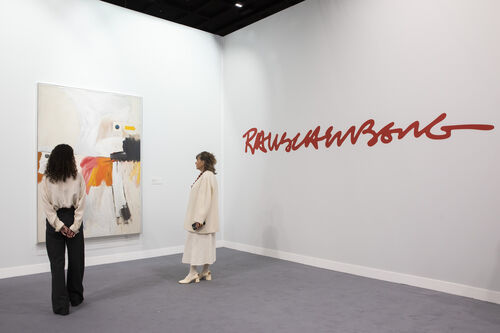
This year, the fair’s ethos is inspired by the 100th anniversary of Rauschenberg’s birth and the artist’s collaborative way of working, which is reflected both conceptually and structurally in miart 2025. It is further reinforced by the fair’s title, “among friends”—borrowed from the last museum retrospective dedicated to the artist, which was held at MoMA in 2017.

“We wanted to bring Rauschenberg’s work back to Italy, where his work hadn’t been shown in over 24 years,” Ricciardi explained, emphasizing the importance of partnerships in bolstering Milan’s status as a major art capital.

Galleries are flocking to the city, too. Sadie Coles HQ returns to the fair after a 10-year hiatus, and other major galleries, including Victoria Miro and Esther Schipper, are showing for the first time.

Throughout the fair, there are collaborative booths, including shared booths from Sadie Coles HQ and Sprovieri; NıCOLETTı and Tina; and Arcadia Missa and Misako & Rosen. The fair’s Portal Section is also inspired by Rauschenberg’s collaborative ethos, which the section’s curator, Alessio Antoniolli (director of Triangle Network in London, curator at Fondazione Memmo in Rome, and former director of Gasworks in London), describes as “bringing together ideas, emotions, and solutions all at once.”

Darlene, 2023
Diango Hernández

Wizard Gallery

Victory, 1997
Marina Abramović

Lia Rumma

This spirit of collaboration is evident in this section, with international artists from Ghana, Peru, Colombia, Paris, Berlin, and beyond, bringing their diverse perspectives to explore common global urgencies. “It’s about creating spaces where different ideas not only exist alongside each other but also find points of connection,” Antoniolli told Artsy.

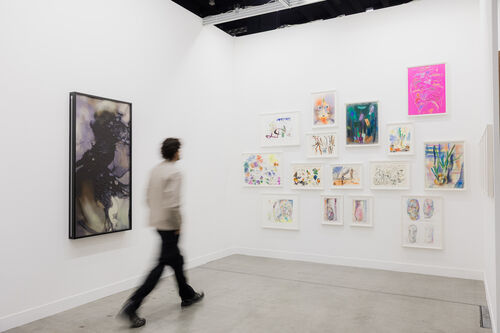
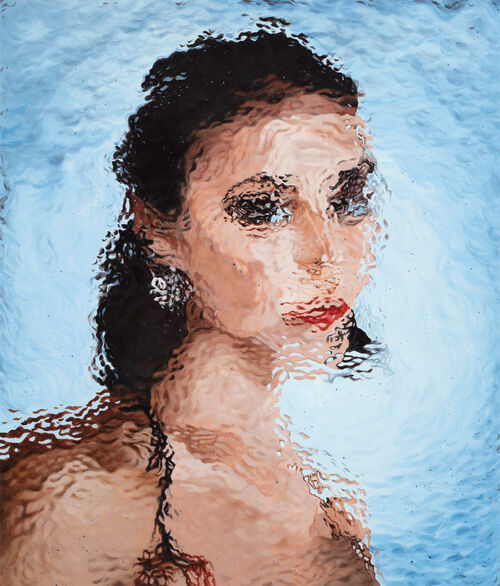
Across the fair’s main section, booths cut across a range of modern and contemporary art, with highlights aplenty. Milan and London’s Cardi Gallery presents stone face sculptures by Ugo Rondinone, while Milan and London’s Wizard Gallery offers standout, frosted-glass paintings by Diango Hernández. Genova and Milan gallery ABC-ARTE is showing works by artists including Arnaldo Pomodoro, Nanni Valentini, and Chiara Crepaldi; Florence and Milan’s Galleria Poggiali showcases a freestanding, folded paper marble plane sculpture by Fabio Viale. Also notable is the Milan and Naples gallery Lia Rumma’s presentation of a range of pieces from artists including Marina Abramović, William Kentridge, and Joseph Kosuth, as well as works from Italian artist Gian Maria Tosatti’s “Fireworks” series, which draws from the Arte Povera movement through the use of rust on galvanized, metal sheet wall works.

Elsewhere, the Emergent section, curated by Attilia Fattori Franchini, highlights younger artists and galleries. Here, a strong contingent of presentations from U.K. galleries is featured, including artworks by Oscar Enberg and Brianna Leatherbury at London’s Brunette Coleman, Jack O’Brien’s work at London’s Ginny on Frederick, and Edward Kay’s series of 10 tempera and oil paintings of apples at Margate’s Roland Ross. Also present are lightboxes by Eva Gold, which glow next to Tasneem Sarkez’s paintings at London’s Rose Easton, and Nate Boyce’s abstract paintings at London’s Ilenia. Italian galleries also offer standout presentations, including Milan and Naples’s Zaza, showcasing a water fountain by Gina Fischli, and Milan’s MATTA, which presents luminous sculptures by The Back Studio. These galleries reflect a younger, experimental approach to contemporary art that complements Milan’s more traditional approach.

As the city also prepares for the Salone del Mobile design week, opening on April 7th, the synergy between art and design is more palpable than ever. The growing energy between the two is reshaping the Milan art scene, and the galleries participating in miart have taken notice.

Milan’s collector demographic is also diversifying, Ricciardi explains. “I keep meeting new people, collectors from the U.K., L.A., and northern Europe, who are moving to Milan to take advantage of these incentives. They’re discovering a city that’s not only more affordable than major capitals like London, but also incredibly dynamic. The food, the culture, the lifestyle—it all adds to Milan’s appeal.”

Ricciardi noted that, as more people relocate, the expatriate community is growing. Its high-net-worth collector base is growing in tandem, partly thanks to its attractive tax regime. Major galleries are also following suit, like Thaddaeus Ropac, which is preparing to open a new gallery in the city, and Ben Brown Fine Arts, which is looking to expand its presence.

This is a view shared by Massimo de Carlo, whose Milan-founded gallery is among the most significant returnees to the fair. For de Carlo, the city’s allure extends beyond the art world: “Milan is an incredibly attractive city—not just for art but for its entire lifestyle,” he said. “Even before the galleries, the city has been drawing people from London, Paris, and Belgium. That influx is helping to create a new artistic ecosystem.” He noted that the city’s cultural institutions, foundations, and overall way of life contribute to this exciting shift.

Still, the fair remains a focal point for Italian collectors. “We anticipate that most visitors here will be from Italy,” shared a representative from Victoria Miro. “There’s a growing trend worldwide where collectors are attending regional fairs rather than travelling as much internationally for art fairs. Milan, as Italy’s financial and economic capital, is a strategic place for us to be.”

The VIP day at miart, although initially slow, soon saw a steady stream of collectors. Indeed, reported sales also followed suit: Leading transactions reported by galleries from the VIP day included a $320,000 Rondinone work at Cardi Gallery, a €150,000 ($165,064) Felice Casorati work at OSART Gallery, and a Giorgio de Chirico work at Galleria dello Scudo priced between €200,000–€300,000 ($220,086–$330,129).

With increasing international attention, strategic tax policies, and an expanding collector base, Milan is positioning itself as a leading global city for contemporary art. As the fair continues to grow, evolve, and collaborate with institutions in the city and beyond, its role in shaping Milan’s artistic landscape will only continue to grow.

News Feed Articles

New York Attorney General Sues Trump Administration Over Museum and Library Funding Cuts

James called the executive order “another attack on vulnerable communities, small businesses, and our children’s education.”
News Feed Articles

Wondrous and Mischievous Misfits Populate Rhea Mack’s Bubblegum Daydreams

Wondrous and Mischievous Misfits Populate Rhea Mack’s Bubblegum DaydreamsOn candy-colored paper, Rhea Mack imagines a world full of misfits and oddballs.

Do stories and artists like this matter to you? Become a Colossal Member today and support independent arts publishing for as little as $7 per month. The article Wondrous and Mischievous Misfits Populate Rhea Mack’s Bubblegum Daydreams appeared first on Colossal.

News Feed Articles

A Music Video for Corridor Is a Frenetic Collage of Our Disordered Attention

A Music Video for Corridor Is a Frenetic Collage of Our Disordered AttentionThe disorienting effects of technology are on full display in this action-packed music video.

Do stories and artists like this matter to you? Become a Colossal Member today and support independent arts publishing for as little as $7 per month. The article A Music Video for Corridor Is a Frenetic Collage of Our Disordered Attention appeared first on Colossal.