
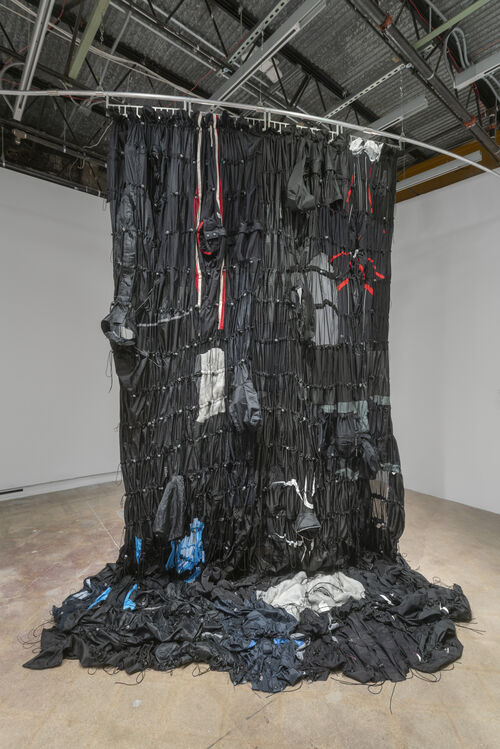
In the mysterious and fragmented world of clothing production, “It’s really difficult to track where something is made, how it’s produced, and under which conditions,” said the Amsterdam-based artist Hendrickje Schimmel. Operating under the name Tenant of Culture, she essentially runs the production process in reverse, taking secondhand garments nearing the end of their life cycles and summarily “unmaking” them. Breaking down eBay or thrift store finds, she told Artsy, she examines their individual parts for clues: “what type of glue is used, the intentions of the designer, how long they’re supposed to last.” From there, the artist reassembles the scraps according to her own formal and conceptual logic, mixing the materials and techniques of disparate eras, functions, and styles.
The resulting works, on view now at her two concurrent, debut U.S. solo shows, offer a critique of industrial overconsumption and waste. Some pieces are deconstructed into total abstractions, while others remain legible as clothing—albeit freakishly altered and radically reimagined.
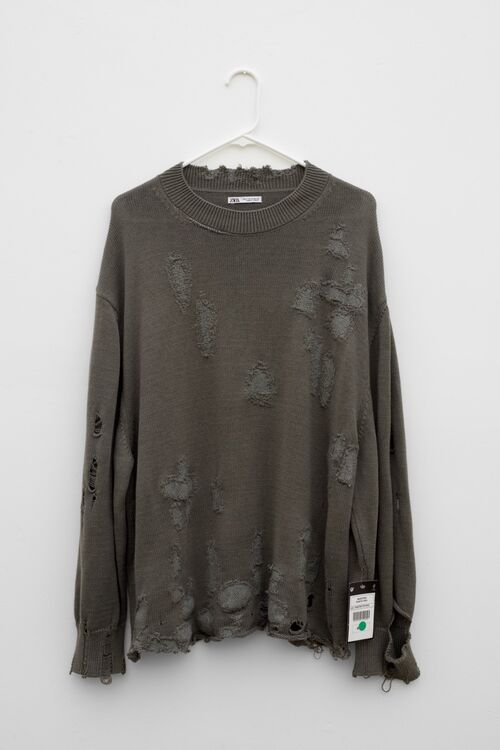
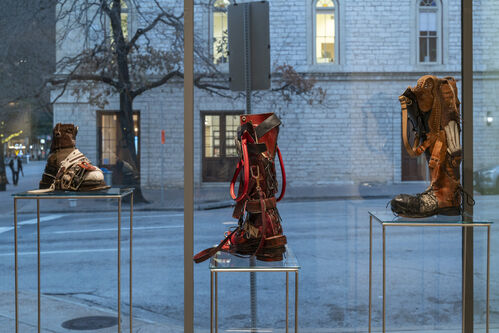
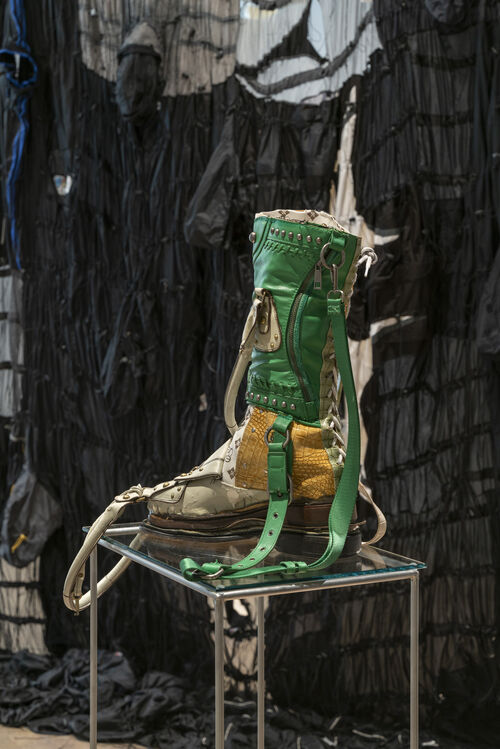
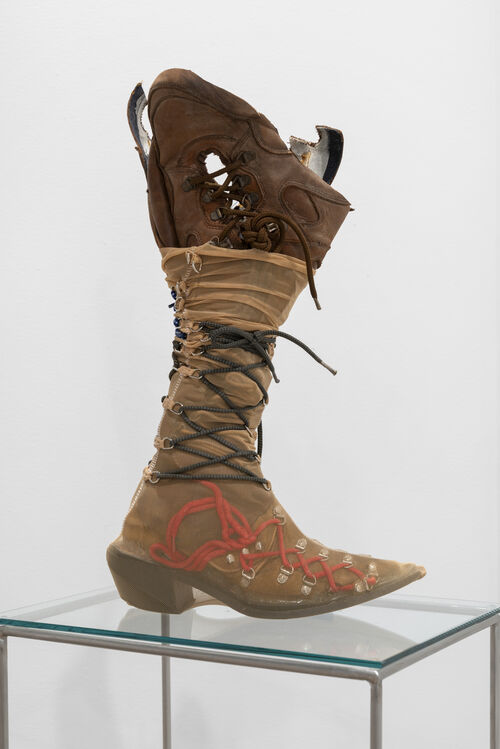
In her conceptual practice, Tenant of Culture is about extending fashion’s notoriously short life cycle, recycling its essentially worthless debris into rigorously constructed sculpture. At “Host: Tenant of Culture” at The Contemporary Austin (on view through August 3rd), Puzzlecut Boot Brown (2021) is a single Frankenstein heel, sutured with purse straps and belt buckles and stacked from the soles of other shoes. “Science and Worms” at Ehrlich Steinberg in Los Angeles (on view through April 5th) features a newer suite of similarly de- and reconstructed footwear, as well as Sabotage in Acrylic (series nr 3) (2025), a piece made from a synthetic Zara sweater that once featured trendy, machine-made holes. Schimmel laboriously repaired them by hand to highlight the difference between “industrial time” versus “craft time”: “Something that was produced in probably less than half an hour took months and months to restore.” Found secondhand with its tag intact, the sweater also embodied fast fashion’s increasingly rapid cycle of replacement; it had been discarded before it was ever worn.
How Tenant of Culture deconstructs the fashion industry
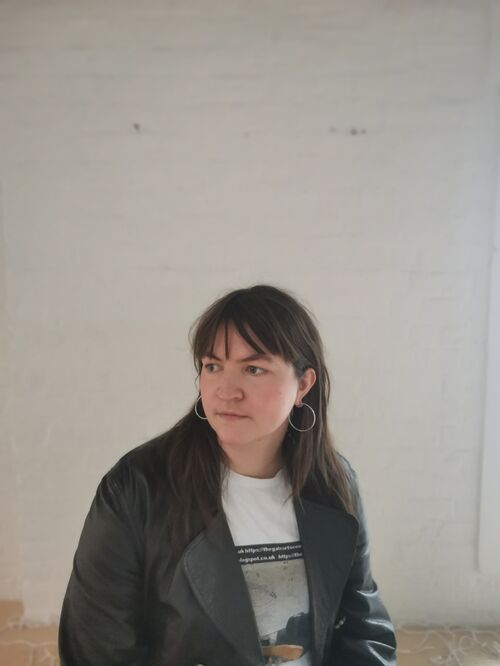
For many years, Schimmel professionally designed outerwear for a mid-sized company, after training in garment-making at London’s Royal College of Art and interning at Alexander McQueen. Ultimately, she explained, she felt alienated by the industry’s secretive production methods and wasteful culture of overconsumption: “Everything that fashion produces is already on its way to be destroyed.”
The artist adopted the name Tenant of Culture as a reference to The Practice of Everyday Life, a 1974 text by the late French scholar Michel de Certeau. He proposed the misuse and reinterpretation of mass-produced goods as a way for consumers to preserve their sense of individuality. The moniker “Tenant” also acknowledges that Schimmel is not permanently tied to any fashion house. “The whole idea of Tenant of Culture is going against the constant material innovation and newness that fashion demands, and seeing how far and how differently you can go with the same materials.”
Textiles in contemporary art are often made or outsourced by artists approaching the medium from an outsider’s perspective, essentially translating the grammar of image making into the language of fiber. By contrast, textile production is Tenant of Culture’s first language; she has the fluency to experiment with the material on a structural level, exploring variations on the traditional stitch the way a painter explores new brushstrokes. “I have my own methods of making that probably don’t at all meet the standards of industrial technique,” Schimmel said. This leaves her free from the practical constraints of making functional clothing.
Paying close attention to trends, the artist incorporates them into different bodies of work, drawing out the historical references frequently forgotten by popular culture. “Eclogues (an apology for actors),” her 2019 show at NıCOLETTı in London, framed the “pastoral nostalgia” surging through high street shops as a strange romanticization of the medieval milkmaid. “Ladder,” her 2023 show at Soft Opening, also in London, was about fashion’s appropriation of distressed fabrics as pure decoration. The 16th-century slashed sleeve trend among European nobility, for example, was inspired by the tattered clothing of soldiers returning from war. Bringing the look into the 21st-century world of e-commerce, Schimmel cut gashes into the packaging of online clothing orders to create “Haul,” a series of strangely beautiful, lumpy soft sculptures of contrasting colors and textures, some adorned with delicately feminine bows.
Artistic preservation and its fashionable decay
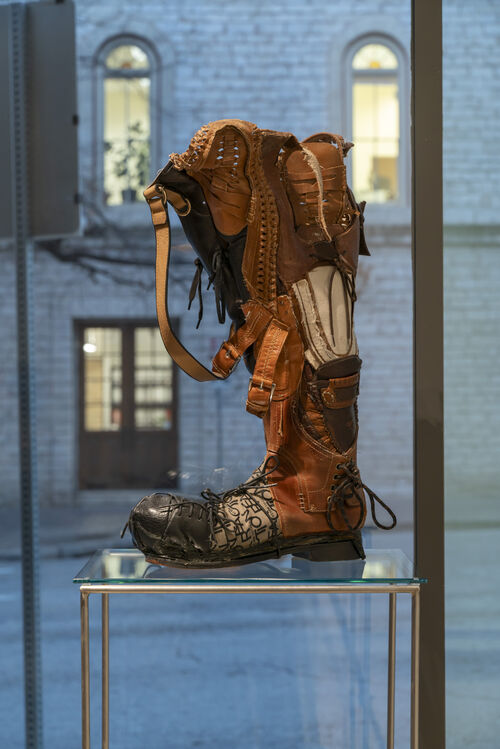
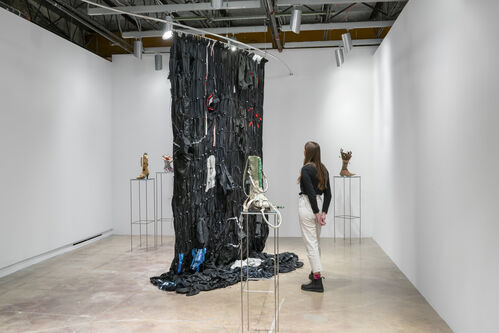
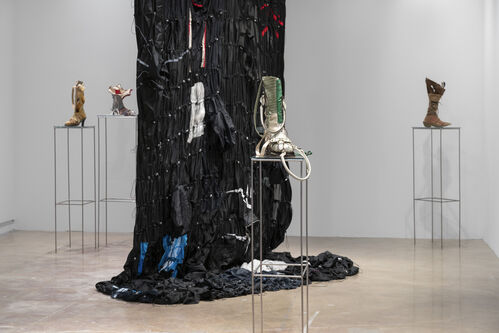
Tenant of Culture is represented by Soft Opening in London as well as Galerie Fons Welters in Amsterdam, and has works in the permanent collections of the Het Fries and Stedelijk Museum in the Netherlands. Her crossover from the fashion industry into the art world has provided interesting new angles to mine. During an early gallery show in 2017, viewers described her work as “trendy.” “I didn’t realize that that was an insult,” Schimmel recalled. In contrast to fashion’s ephemerality, she eventually realized that “the status quo within the arts is that something should exceed a certain time period and last for eternity.”
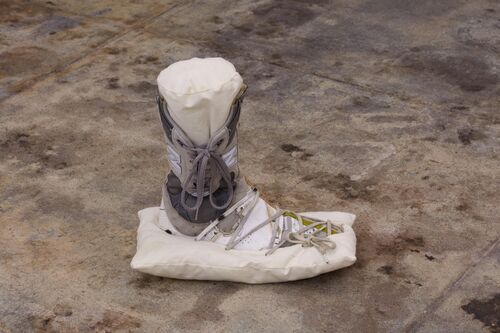
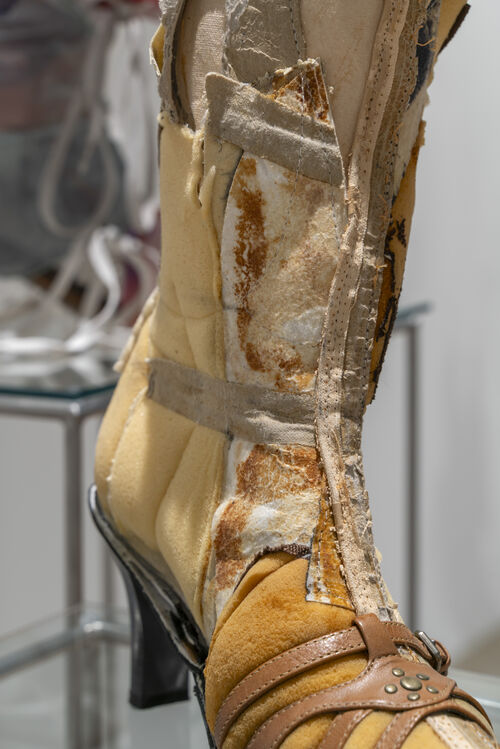
Her current Ehrlich Steinberg show “Science and Worms” merges the contradictions in “fashion time” and “museum time,” abstracting institutional methods of conservation and applying them to shoes that already appear to be falling apart. In her research, Schimmel was surprised to learn “how much effort is put into the preservation of materials that are not meant to be preserved,” she said, as well as some conservators’ desire to maintain the exact point of an object’s existing decomposition. Among her new “Receptacles” sculptures of deconstructed shoes, some are fused at the sole to strange cushions inspired by those in the MFA Boston’s costume archives. Others, fittingly, are held together inside transparent “tombs” of plastic and rubber sleeves. The title refers to Baudrillard’s idea that, in taking cultural artifacts out of their organic context, museum preservation is its own type of unnatural death.
As an ardent critic of the fashion industry, Schimmel is still deeply invested in its artistry and the importance of personal style. She highlighted an important distinction within her practice: “What I am critical of is fashion and its extractive methods as an industrial complex, not fashion as a joyful and important daily practice for so many,” she said. Plus, “I think criticism is much more interesting if you actually really like something.”