Mark Mulroney’s “Clark”
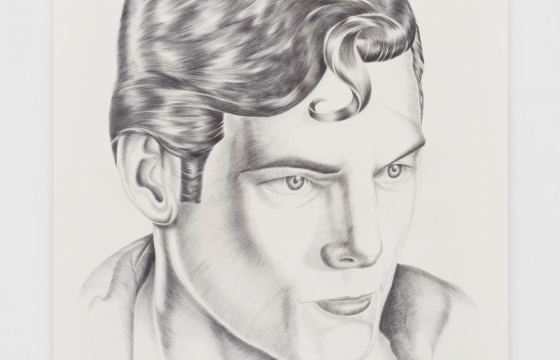
Mrs. is pleased to announce Clark, a presentation of new works by Mark Mulroney. This is the artist’s third solo exhibition with the gallery.
Chicago Fire FC is kicking off the 2025 ML…

The increasingly blurred boundaries between labor and domesticity are the subject of an exhibition of 24 artists who graduated from the program last year.

A show of 10 artists working from the 1910s to ’70s demonstrates that the movement was much more diverse than its most notable names suggest.

Untitled (parabolic lens), 2022
Fred Eversley
David Kordansky Gallery
American artist Fred Eversley, who quit his aerospace engineering job to pursue art, died at 83 on March 14th. David Kordansky Gallery, which started representing the artist in 2018, confirmed the artist’s death, which followed a brief illness.
With a career spanning five decades, Eversley is most closely linked with the Light and Space Movement of California in the 1970s. His sculptures, crafted from resin and noted for their glossy, transparent qualities, are inspired by scientific phenomena. In recent years, the artist also began working with stainless steel. In November 2024, Eversley unveiled his largest public installation, a 16.5-foot-tall parabolic steel sculpture titled Portals (2024), in West Palm Beach, Florida, near the historic First Church of Christ, Scientist, designed by architect Julian Abele.
Born in Brooklyn in 1941, Eversley pursued science from an early age. Inspired by his father, who worked as an aerospace engineer, Eversley studied electrical engineering at Carnegie Mellon University. He graduated from the program, where he was the only Black student at the time. After graduating, Eversley took a job at Wyle Laboratories, a company that supported the Apollo missions at the National Aeronautics and Space Administration (NASA).
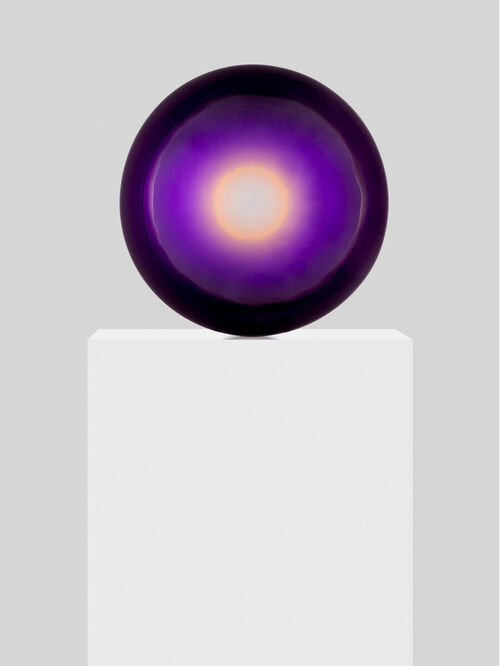
Untitled (parabolic lens), 2022
Fred Eversley
David Kordansky Gallery
Before becoming an artist, Eversley began to form relationships with artists around Los Angeles. He offered technical advice to Light and Space artists such as Larry Bell. His life took a turn in 1967, when he crashed his car. While recovering for around 13 months, the artist was introduced to polyester resin by artist Charles Mattox. By 1969, he took over John Altoon’s studio in L.A., where he began to make his parabolic sculptures. Soon after, Eversley quit his job at Wyle and decided to pursue art full-time.
Eversley’s work was inspired by his scientific training. He became known for his parabolic resin sculptures, but he took an interest in several other interstellar forms, such as dead stars or black holes. He began with small sculptures; however, as his career progressed, his works became increasingly larger. Examples of these sculptures include the eight-foot-tall “Cylindrical Lenses,” most recently shown at David Kordansky Gallery in 2023 and 2024.

Untitled (cylindrical lens), 2024
Fred Eversley
David Kordansky Gallery
Eversley was chosen as the first artist in residence at the Smithsonian’s National Air and Space Museum in 1977. Though he did not gain gallery representation until 2018, his work was the subject of institutional solo shows at the Whitney Museum of American Art in 1970, the National Academy of Science in Washington, D.C. in 1981, the Muscarelle Museum of Art in Virginia in 2017, and the Rose Art Museum in Waltham, Massachusetts in 2017.
In 2023, Eversley unveiled one of his largest works, Parabolic Light (2023), a 12-foot-tall transparent resin sculpture, at Doris C. Freedman Plaza in front of New York’s Central Park. The sculpture was commissioned by Public Art Fund. The same year, Carnegie Mellon University awarded Eversley a doctor of fine arts degree.

Despite their technical basis, his work is all about the relationship between the viewer, the artwork, and the world as it is reflected and refracted, themes he never tired of exploring.

With a fair dose of whimsy, Also on View draws attention to museums off the beaten track, centering the region’s rich diasporic fabric and cultural niches.

Hauser & Wirth has announced its representation of South Korean artist Lee Bul. The gallery will co-represent the artist with her Seoul-based gallery BB&M. Lee was previously represented by Thaddaeus Ropac and Lehmann Maupin, which have both shown her since 2007.
Two of Lee’s works will be featured in Hauser & Wirth’s booth at Art Basel Hong Kong next week: a leather-covered fiberglass and steel sculpture Untitled (Anagram Leather #11 T.O.T.) (2003/2018) and a new diptych painting Perdu CCIX (2025). The artist’s first exhibition with the gallery will take place in New York in 2026.
Lee is renowned for her interdisciplinary practice, spanning four decades and encompassing sculpture, installation, performance, and painting. Her work often examines the impact of technology on our lives while incorporating cyborg imagery to explore themes of posthumanism and gender politics. She is perhaps best known for her “Cyborgs” and “Anagrams” series, using unconventional materials like silicone, fiberglass, and acrylic beads to imagine futuristic bodies.
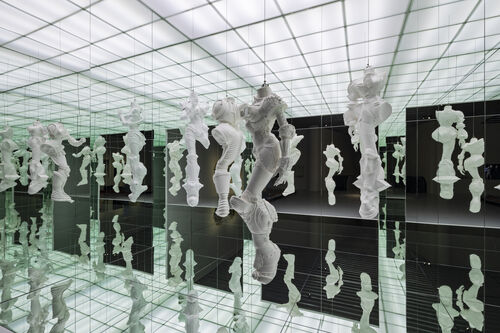
“Lee is recognized as the foremost Korean artist of her generation,” said Hauser & Wirth president Marc Payot. “Combining conceptual rigor and a nuanced approach to materiality with a deep and profound humanism, her work continues to evolve in fascinating new directions. Now in the fourth decade of her career, she is seen as a pioneer by younger generations of artists who are deeply influenced by the sensibility of her early work, her iconoclastic performances, and the multi-sensory installations that expanded the formal and conceptual boundaries of visual art.”
Born in 1964 in Yeongju, South Korea, Lee graduated from Hongik University with a BFA in sculpture in 1987. She gained prominence in the 1990s, particularly with her massive installation, Majestic Splendor (1997). This work, which featured decomposing fish adorned with sequins, was showcased at the Museum of Modern Art in New York. It was later selected by curator Harald Szeemann for his 1999 Venice Biennale exhibition. That same year, Lee presented two installations at the Korean pavilion in Venice.
Throughout the 2000s, Lee presented solo exhibitions at prestigious institutions, including the New Museum in New York and Fondation Cartier pour l’art contemporain in Paris. Her work has been exhibited on the biennale circuit, including the Venice Biennale in 2019, the Sydney Biennale in 2016, and the Bangkok Art Biennial in 2018.
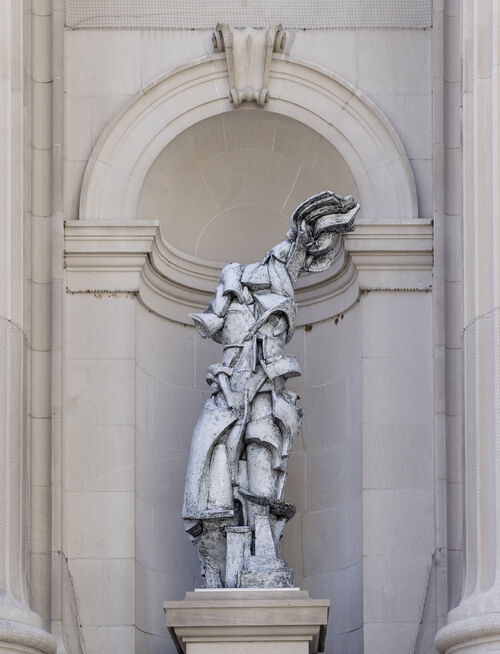
In 2024, the Metropolitan Museum of Art in New York commissioned Lee to design sculptures for the niches of its iconic Fifth Avenue facade. The exhibition titled “The Genesis Facade Commission: Lee Bul, Long Tail Halo” will be on display until June 10th.

Davis portrayed scenes in which Black people could truly recognize themselves, eschewing stereotypical depictions and imbuing his subjects with a sense of the surreal.