Arpita Singh’s Visionary Paintings Are Finally Gaining International Recognition

Several women appear in Arpita Singh’s 1989 painting Munna apa’s garden. One, middle-aged, waters her flowers, while another on the right watches on through floral curtains. Through a window in the center-top of the painting, a woman appears bare-chested. These figures, windows, and flowers appear in canvases throughout Singh’s career. “I always paint the things I see and experience every day,” the artist said in an interview with Hans Ulrich Obrist, artistic director of the Serpentine Galleries, for the show’s catalogue. “They’re almost the same every day.”
“Remembering,” at the Serpentine North, is Arpita Singh’s first institutional solo exhibition outside India. The exhibition surveys a 60-year career with an emphasis on Singh’s unique approach to figuration and world-building. While Singh is one of the best-known painters in India, international recognition has been slower to arrive. The Serpentine show comes on the heels of important recent shows of Indian art in the U.K., such as the widely praised 2024 exhibition “Imaginary Institution of India: Art 1975-1998” at the Barbican Centre, which showed works by Singh in the context of close Indian peers and collaborators such as Nilima Sheikh, Nalini Malani, and Madhvi Parekh.
In this new solo show, the singularity of Singh’s career comes into focus. With a total commitment to finding a language for her personal life, she uniquely reinterprets Indian folk and modernist traditions alongside Western Surrealism, inspiring, as Obrist said in an interview with Artsy, “five generations of Indian contemporary artists.”


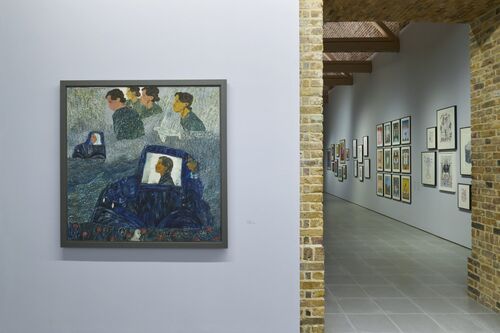
Singh’s large oil paintings, in which figures navigate their domestic, urban, and political everyday realities, hang along the perimeter of the Serpentine gallery, following the artist’s practice chronologically. Two inner chambers in the exhibition house more intimate works in watercolor and ink, including early abstract drawings, etchings, and a set of 12 zodiac-inspired works—hints of the spiritual and mythical dimensions that guide the artist’s sense of her “everyday.”
In place of traditional interpretive texts, personal reflections—including contributions from curators, critics, longstanding friends of the artist such as Sheikh, and authors such as Devika Singh, Geeta Kapoor, and Geetanjali Shree—accompany the works, providing a sense of interpersonal context for Singh’s life.
Singh’s maplike paintings

Singh’s oeuvre, Obrist explained, takes the form of an atlas. “There is something to see in every centimeter. She pastes together a world,” he said. Singh’s dense, pictorial planes are often flat, with figures arranged in a space without gravity. This technique is similar to South Asian miniature painting traditions—an important inspiration for Singh.
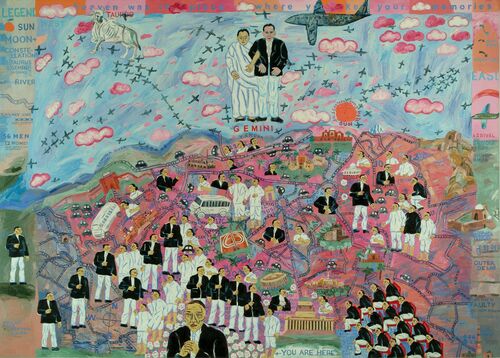
This “bird’s-eye view” approach also recalls the visual language of maps. In My Lollipop City: Gemini Rising (2005), figures resembling bureaucrats stand on a political map of New Delhi, complete with the city’s road names, landmarks, and monuments. The top of the painting shows a sky with crisscrossing planes, annotated with the names of constellations. Here, Singh systematically builds her personal world, where there may not be gravity but, she told Obrist, there is still “a law, but a law according to me.” Her laws aren’t too rigid, however: As Singh notes in the bottom-right corner of the work, “THE MAP IS FAULTY DO NOT FOLLOW IT.”
Other works are also filled with cartographic references. In one of the artist’s best known works, My Mother (1993), a road runs diagonally across the canvas, separating neighboring territories. Cars, bicycles, chairs, soldiers, women in bikinis, and crosses crowd one section, while the other is filled with a half-length portrait of her solid, scowling mother.
Singh’s reference to the map and its sometimes noisy motifs nod to the geopolitical currents that set the stage for her painterly world. The artist was born in West Bengal in 1937, and saw India through its independence and violent partition from Pakistan in 1947, then a state of emergency in 1975, and its economic liberalization through the 1990s. Contemporary political tensions are a constant part of her life, even if they do not confine her practice. In a 2024 interview with Tamsin Hong, curator of the Serpentine exhibition, Singh said, “I read the newspaper…everyday.”
Indian artists in the world
Singh went to art school on the advice of her high school principal, without even realizing it was a field of study at the time. After graduating with a diploma in fine arts from Delhi Polytechnic in 1959, Singh went on to work as a textile designer at the Weaver’s Service Centre, a postcolonial institution that appears in the biographies of many of India’s most important artists, including Prabhakar Barwe and Monika Correa. By the time Singh began living and working in New Delhi as a painter, she had already encountered many of her lifelong inspirations—Bengali poetry, Western Surrealist art, and Indian narrative folk traditions such as pattachitra and kantha embroidery.
The first conversations for “Remembering” began in the artist’s studio in New Delhi more than 15 years ago, when Obrist first met Singh while researching the Serpentine’s survey of Indian art, “Indian Highway.” The 2008 exhibition was called an “unprecedented spectacle” by The Guardian for its role in introducing many in the U.K. to Indian modern masters, such as M.F. Husain, and those who have since exploded in the international scene, such as Shilpa Gupta.
The market for Indian modern and contemporary art seems to have grown in parallel to institutional attention, with galleries, art fairs, and auction houses reporting consistent success and expansion over the past few years. The same week “Remembering” opened in London, Sotheby’s New York made record sales for a number of Indian modern and contemporary artists. Meanwhile, Christie’s recorded the top auction price ever paid for an Indian modern artist, selling a large, 13-panel M.F. Husain painting for $13.75 million (including fees).

“Galleries, collectors, curators, and institutions have all been working hard and collaborating to bolster the Indian art scene and this has paid off,” said Roshini Vadehra, Singh’s New Delhi gallerist and key collaborator for “Remembering.” Vadehra is a member of this robustly international South Asian art world, and her roster has been on view in London through presentations at No. 9 Cork Street and in institutional exhibitions such as “The Imaginary Institution of India” at the Barbican and the upcoming “A Story of South Asian Art: Mrinalini Mukherjee and Her Circle” at the Royal Academy of Arts.
“Many Indian artists bring something unique,” she said, noting the rising popularity of Indian art internationally. She put this down to “a blend of historical traditions and contemporary relevance that speaks to global concerns: identity, politics, gender, and social transformation, for example.”
Arpita Singh’s feminine figures
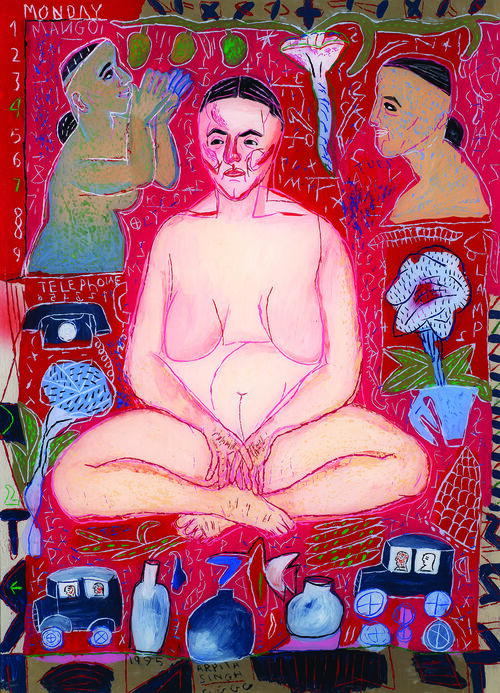
An ambiguous feminine figure is often the protagonist of Singh’s paintings. Sometimes, she stands in for a real woman. For example, in her interview with Hong for the exhibition, Singh recounted her mother greeting her nephew at the door in exactly the same manner as the figure in My Mother.
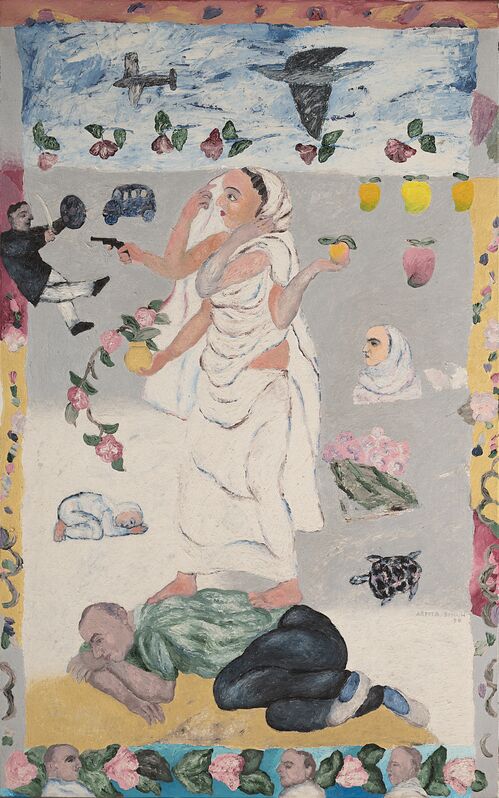
Elsewhere, feminine figures stand in for women more generally. Devi Pistol Wali (1990) reimagines Kali, the Hindu goddess of vengeance and destruction, as an unassuming, contemporary Indian woman in widow’s whites standing atop a prostrate man. Her four hands hold, respectively, a mango, a vase with trailing flowers, the titular pistol, and her own pallu (the part of the sari covering her head). The vehicles common in Singh’s paintings surround her, alongside turtles, more flowers, and other humanoid figures. The symbolic figure of the goddess is replaced with the varied life of a contemporary woman, as told through the mundane objects that surround her, rendered in thick, layered paint.
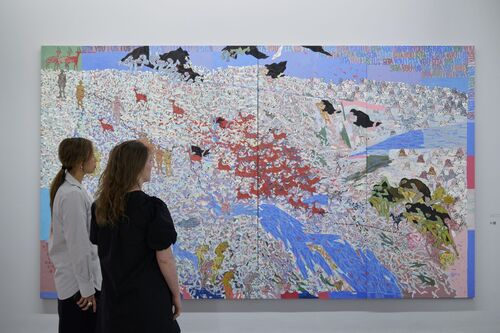
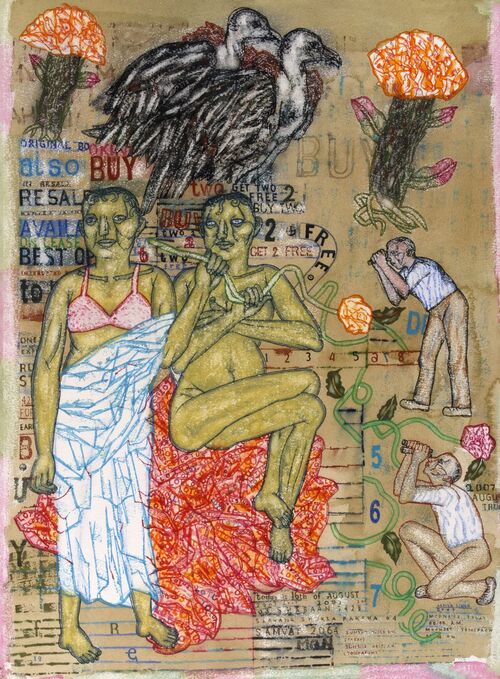
The mythological woman is invoked in many of Singh’s works. In Searching Sita through Torn Papers, Paper Strips and Labels (2015), the figure of Sita, an icon of chastity, purity, and martyrdom in the Hindu epic the Ramayana, is only present in the title of the work and appears to have disappeared from the canvas. Words such as “MISSING,” “TRAPPED,” and “SLANDERED” take her place, painted to seem as if collaged from newspaper clippings. The work marks Singh’s engagement with rising concerns for violence against women in India at the time. As the individual meaningful words are subsumed in a dense roar of letters across the canvas, Searching Sita hints at Singh’s conception of her work as a quest, seeking something elusive.
“Painting is always fascinating,” said Singh, when asked why she keeps at it. “I saw a very small child make a painting with red, and she was painting the red colour again and again. I said, ‘Why are you doing it again and again?’ She said, ‘It’s not red enough.’ It’s like that for me too.”