Trump Moves to Fire Caretakers of Federal Art Collections
The White House has expressed interest in terminating staffers and ending the leases of properties that house public art.
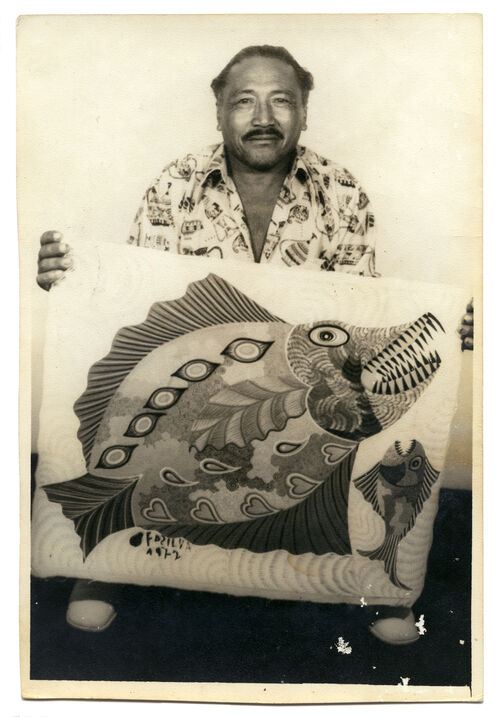

In the early 1940s, striking murals began to appear on the walls of modest fisherman homes along the beach in Fortaleza, Brazil. These images of mythical creatures, rendered in charcoal and chalk, spawned from the imagination of then-unknown Brazilian Indigenous artist Chico da Silva. These pictures, portraying sharp-beaked birds and colossal fish, were how Chico taught himself to draw.
In 1943, Swiss art critic Jean-Pierre Chabloz first stumbled upon Chico’s work, and was so struck by its originality that he became Chico’s patron and champion. This support catapulted Chico to international fame, culminating in the inclusion of his work in the Brazilian pavilion at the 1966 Venice Biennale and the 1967 São Paulo Bienal.
This attention would soon turn sour. Coinciding with his success, the Brazilian artist had founded the Pirambu School, an informal workshop that evolved into his collective art practice—a studio approach reminiscent of Andy Warhol’s Factory. However, this collective approach did not sit well with Chabloz, who publicly denounced the artist’s practice and questioned its integrity. This condemnation, coupled with Chico’s escalating alcoholism, precipitated a decline in his popularity, causing his legacy and work to remain on the fringes long after his death in 1985.

Four decades later, Chico is now experiencing a renaissance. Tomorrow, David Kordansky Gallery is opening “Amazônico,” a solo exhibition of Chico’s works from the 1960s, alongside three rarely seen works from the 1980s, on view through April 26th. In 2023, the gallery mounted the first major solo show of Chico’s work in New York, which coincided with the largest survey of his work to date at the Pinacoteca de São Paulo. In the last two years, Chico’s work has been presented worldwide by galleries such as Secci, MASSIMODECARLO, and Almine Rech. Now, the show at David Kordansky Gallery demonstrates that Chico’s work belongs in the annals of both Brazilian art and the art world at large.
Instead of a survey, “Amazônico” presents a more selective introduction to some of Chico’s essential works. Here, these 15 works exemplify some of the best of Chico’s creatures, all of which are decorated with a hypnotic pointillist technique, providing an entryway to understanding the long-neglected artist. Ana Lopes, artist liaison at David Kordansky Gallery, explained that the gallery was putting on the show of Chico da Silva to show “how central he is of a figure painting in Brazil, how prolific he was, and how immensely successful it is.”

Born in the Amazonian region of Alto Tejo, Brazil, around 1910, Chico da Silva was shaped by his early years spent in the rainforest, a region teeming with the biodiversity that later populated his work. After his father’s death from a rattlesnake bite, Chico and his mother moved to Pirambu, a coastal town in eastern Brazil. It was here, as a teenager and young adult, that Chico first began visualizing his creatures—inspired by birds, snakes, iguanas, fish, and more—on the walls of seaside homes.
“I was fascinated by the ways in which his career followed the trajectory of so many [contemporary] art stars and sort of presaged so many people in a way like Banksy,” said Graham Steele, a private dealer and collector of Chico’s work who has been crucial in reviving the artist’s legacy. “He was discovered by painting essentially graffiti murals in the small towns where he was living and working as a carpenter.”

Chabloz provided Chico with his first painting supplies—gouache paint, durable paper, and canvases—encouraging the development of his distinct style, characterized by mythologized renderings of fauna and flora composed with meticulously arranged patterns. These early works feature kaleidoscopic, grotesquely shaped creatures, often epic in proportion and popping with bright gouache paint on paper.
For instance, an untitled piece from 1960–65, one of the earliest in the show, features an intricately patterned and colorful depiction of two birds, surrounded by a richly textured background suggesting foliage or feathers. The warm earth tones, combined with greens and reds, create a visually dense composition that emphasizes the natural forms and decorative quality of the birds.

Chico frequently reused patterns across different pieces over the years. Several featured works from 1964 and 1966 incorporate similar stippled patterns on his creatures. For instance, one untitled work from 1966 features a fish with alternating blue, red, and green scales that appears once before on a sea monster in a 1964 painting. Elsewhere, the rippling scales on the three fish in Untitled (1964) closely resemble those on a dragon-iguana hybrid depicted in a 1967 piece.
As Chico refined his style, his paintings began to feature creatures suspended against abstract, almost ethereal backdrops—often bright yellow environments devoid of horizon lines or suns. In a 1968 work featured at David Kordansky Gallery, two gnarled bird-like creatures battle against one such yellow background, allowing the reds, greens, and blues to stand out. These battles became an increasingly prominent theme in his later works. By this time, his work had caught the attention of the international art world, largely thanks to Chabloz’s and Chico’s first dealer, Henrique Bluhm.

Back home in Brazil, Chico was channeling his refined techniques into the Pirambu School. Initially envisioned as a workshop for children and local artisans (banned, like all collective gatherings, under the military dictatorship of the time), the school rapidly evolved into a place for collective practice. Here, studio assistants learned from Chico while also crafting their own pieces, effectively broadening the artist’s own visual language.
European and American critics often distorted the narrative surrounding Chico’s studio practice, labelling the work as the “primitive” or “naïve” product of an Indigenous artist. And yet Chico’s approach could also be seen as revolutionary in its own right, said Lopes. “A lot of the narratives that were built around Chico when he was gaining his success, being [a] ‘primitive artist’—this did not align with [Chico’s] very contemporary and radical studio practice,” she said.

“These are all an amazing, imagined universe,” said Steele. “Of course, they come from legends, from animals that he’d seen, but there’s so many more things that he’s imagining. He’s taking quite traditional markmaking and brushwork…and really expanding it and making it 100% his own. He created a language, and he created a style of painting that then was embraced and continued by the school.”
However, the school infuriated Chabloz, who accused Chico of saturating the market by increasing the volume of works produced through the Pirambu School, as well as taking credit for the work of studio assistants. With Chico’s growing international profile, bolstered by his appearance at the Venice Biennale, there was growing scrutiny and further questions of authenticity that ultimately dismissed him from the international stage.

Untitled, 1980
Chico da Silva
David Kordansky Gallery
Alcoholism made things worse, pushing Chico into frequent hospital stays at rehabilitation centers. Despite the challenges, his passion for painting endured; while hospitalized, Chico continued to produce several critical works. By the late 1970s, he had returned to his studio, albeit with diminished health. “He left inpatient treatment in 1978-ish, and from then on, his health was really never the same,” said Lopes. “He operated on a much smaller scale, but what he did was far more focused and really directed towards a kind of legacy—a consolidation.”

Untitled, 1980
Chico da Silva
David Kordansky Gallery
Some of these final paintings revisit his mythic animals with nostalgia, two of which are on view at David Kordansky Gallery. One example, Untitled (1980), features two dueling reptilian creatures with jagged teeth, hypnotic eyes, and stippled bodies. However, rather than a traditional void-like background, the creatures are superimposed onto a grid of animals in circular frames, drawing from snakes, birds, and mythical sea creatures in previous paintings. The second, another untitled work from 1980, is evocative of a quilt featuring 12 small scenes, each a vignette of his fantastical natural forms. According to Steele, these works serve as “mini-retrospectives,” offering a window into the artist’s forgotten oeuvre.
Even after the art world turned its back on him, Chico never stopped painting a world as fantastical as the one he first envisioned on the walls of Fortaleza. His work, populated by hypnotically patterned creatures, is enchanting the art world once again, anchored by the same bold originality that first earned it acclaim 60 years ago.

The Center for Craft will award up to six $5,000 fellowships to support research on underrepresented craft histories, culminating in an article on Hyperallergic.
 In Nahuatl, an Aztec language indigenous to Mesoamerica still spoken by more than a million people throughout Mexico, “kauani” means “to flourish.”
Do stories and artists like this matter to you? Become a Colossal Member today and support independent arts publishing for as little as $7 per month. The article In ‘KAUANI,’ Indigenous Mexican Flora Flourishes in Glowing Lanterns appeared first on Colossal.
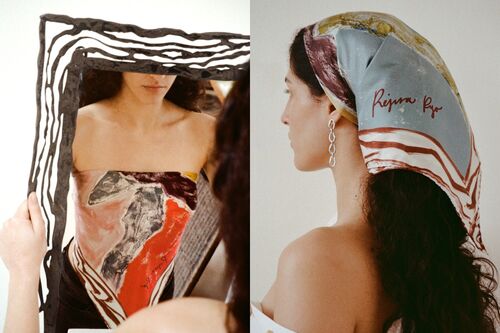
Fashion designer Rejina Pyo will launch a fashion collection inspired by Edvard Munch in partnership with the Munch Museum in Oslo. The collection will debut in London to coincide with the opening of the “Edvard Munch Portraits” exhibition at the National Portrait Gallery on March 13th.
Featuring a collection of silk shawls, bespoke jewelry, and a hand-crafted, patinated steel mirror, the collection will be available at the National Portrait Gallery, Pyo’s Soho store, and the Munch Museum. Pyo found inspiration after studying the artist’s archive at the Munch Museum and the artist’s studio in Oslo. In particular, the designs draw heavily on Munch’s woodcut printing technique. The artist is known for his color contrasts and meticulous application of the technique, which imparts a painterly effect.

A series of chain-link jewelry—bracelets, earrings, and necklaces—takes inspiration from Munch’s fluid brushstrokes. Meanwhile, the mirror is intended to evoke Munch’s use of self-portrait framing, seen in several works at the National Portrait Gallery show. Lastly, the silk scarves will be released with two unique prints that reflect Munch’s color blocking, in reds, yellows, and blues.
“The scarves, in particular, were a joy to create—sculpting shapes and painting in a manner similar to Munch’s woodwork technique felt like a dialogue between his past and the present, bringing his artistry into the everyday,” said Pyo.
Pyo made her first foray into the art world when she curated “As She Is” at Soho Revue in November 2024. For that show, the designer selected 19 artists, including Caroline Walker and Ángela de la Cruz, to explore themes of womanhood.

HANDS, FIGURES AND MIRACLE ACT I, 2025
Joël Andrianomearisoa
Almine Rech
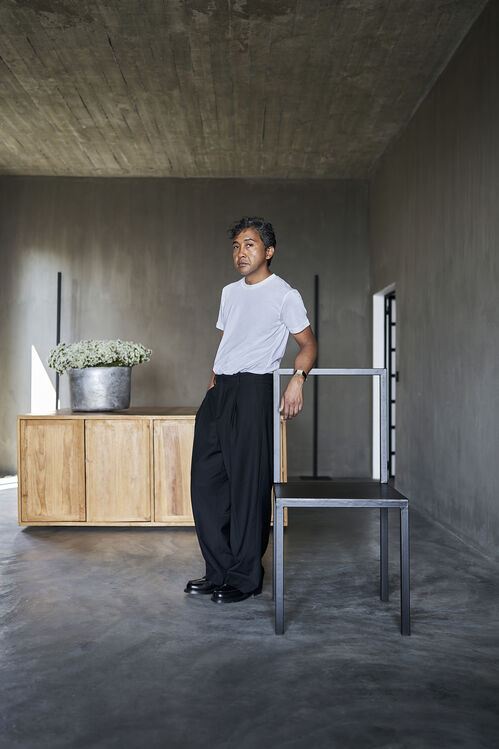
“I have two studios, and the two geographies are very important,” said Joël Andrianomearisoa. One is located in Antananarivo, Madagascar—where the artist grew up—and the other is in Paris. Andrianomearisoa is a big believer in artistic versatility, having made his mark everywhere from international exhibitions with fashion brand Dior, to collaborations with high-end scent brand Diptyque, to showing his work at Madagascar’s first-ever national pavilion at the Venice Biennale in 2019.
Now, in a new forthcoming show—his first solo at a commercial gallery in the United States—Andrianomearisoa is bringing his elegant, spare artworks to wider audiences. Curated by Larry Ossei-Mensah, “Miracle” (at Almine Rech’s Upper East Side space in New York, on view through April 19th) is conceived as a tribute to the craftspeople who manifest his ideas. He’s excited to show “something sophisticated, handmade” in the big city. The exhibition is divided into three parts but champions one medium: raffia, from Madagascar. He decided to “challenge” the material by cutting, rearranging, knotting, or embroidering.
Artworks in the show include clusters of raffia-sculpted flowers languishing off one canvas and raffia words on canvas—spelling out “ALPHABET OF OUR DESIRES”—in another. Another, HANDS, FIGURES AND MIRACLE ACT I (2025), is a contemplative landscape-like cascade of raffia strips in beige and black. These works all highlight this beloved natural material and highlight the work of the technicians who manipulate it so expertly.

MIRACLE ACT ACT XIV, 2025
Joël Andrianomearisoa
Almine Rech

MIRACLE ACT III, 2025
Joël Andrianomearisoa
Almine Rech
The show is part of a wider moment for the artist, who has a simultaneous show of minimalist black-marked canvases at Sabrina Amrani in Madrid. Moreover, his work will soon be displayed elsewhere in New York on the Upper East Side: in the collection of the Metropolitan Museum of Art, within the new African Art wing, opening in late May. The large textile work, three meters by two meters, stems from a series started five years ago, “La chanson de ma terre lointaine.” Its neighbor will be a piece by Ghanaian artist El Anatsui.
Andrianomearisoa heads to the studio in the late morning. His Paris space, in the 14th arrondissement, is near the Institut Giacometti and the Cimetière du Montparnasse (where Marguerite Duras, Charles Baudelaire, and Serge Gainsbourg are buried). He works with a team of eight people; they all gather around a large table where they discuss, organize ideas, and eat together. “The studios are like houses,” he said—a conception that is unsurprising, given that Andrianomearisoa studied at the École Spéciale d’Architecture in Paris.
He’s referring not just to architecture, but fashion, too. His relationship to craftsmanship is integral to his practice in the way haute couture silhouettes require specialized skills and many hours of painstaking work. He is taken by the idea that in one maison, thousands of participating hands and minds are working across a wide spectrum, “but they are thinking about one statement.”


In fact, he’s seen the reality of a maison de couture up close, having been selected to create a signature Lady Dior bag. He was wowed by the speed and rigor of luxury production standards: “On the art scene, sometimes it takes years—like, centuries—to produce something, or to organize a show. With Dior, it’s very fast…they know how to work on it. It’s absolutely fascinating how they can create something new in a day,” he said.
The artist, whose work is included in a current Dior exhibition in Riyadh with another in the works for the end of the year in Tokyo, is presently a brand ambassador for Dior. It’s not the only brand he’s worked with. Andrianomearisoa also collaborated with candle and perfume brand Diptyque on the group exhibition “Le Grand Tour,” for the French perfumer’s 60th anniversary in 2021, as well as on a sculptural installation with them for Paris+ par Art Basel in 2023. (“It was really a booth. Not just a name plus a name.”)

In addition to his personal practice, Andrianomearisoa is also artistic director of a space he founded, Hakanto Contemporary. The 300-square-meter space, inaugurated in 2020, has hosted both group shows and solo shows of overlooked native Malagasy artists like Dany Be or Ramily. “We’re not following trends. We are following our moods and what we appreciate,” Andrianomearisoa said. In September, Hakanto Contemporary graduated to a 3,000-square-meter space, a former warehouse Andrianomearisoa redesigned himself, that will be able to accommodate large installations. Next year, he plans on opening an exhibition juxtaposing craftsmanship and art.
There are things he wishes people knew about Madagascar, and the art world there. “It would be nice if people could stop thinking that Madagascar is just an island with monkeys and palm trees,” he said. “We have our economy, also our art history. We have to go beyond this idea of the exotic.” He wants the country to be regarded as more than just a vacation spot. “It’s like if I’m telling you that Paris is a baguette,” he reasoned. “It’s just not true.”