Su Yu-Xin’s Metonyms for the Earth

Her research-based paintings close the gap between subject matter and material by depicting natural phenomena via the elements that comprise them.
New articles from various feeds.
Her research-based paintings close the gap between subject matter and material by depicting natural phenomena via the elements that comprise them.

With staff cuts set to go into effect in just three days, workers and unions hope there’s still a chance the museum might reverse course.
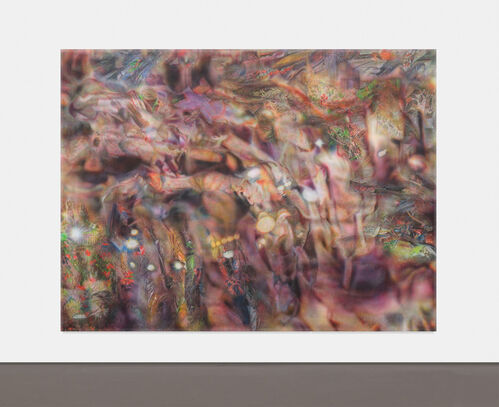
Crowds Drift With The Wind, Gradually Dissipating Like A Whisper, 2024
Bai Yiyi
Swivel Gallery
In this monthly roundup, we spotlight five stellar exhibitions at small and rising galleries.

Poison Fan, 2025
Mira Mann
DREI
In German artist Mira Mann’s Cinémathèque Moranbong (2025), two Kodak Carousel slide projectors display images of North Korean dancer Ahn Seung-hee performing a traditional “swords” dance. Originally captured by French photojournalist Chris Marker during his 1958 visit to North Korea, these images have been reinterpreted by Mann, who used magnifying glasses to photograph the details. Presented in a dual projection slideshow, the projections simulate the dancer’s movements. This work is the heart of Mann’s exhibition “Solo” at DREI.
Many works in Mann’s exhibition are related to the performances and influence of Choi Seung-hee, the mother of Ahn and a world-famous Korean dancer. Through the use of electric motors and technology, Mann’s kinetic sculptures resonate with the movement of dance. For instance, Poison Fan (2025) features two brightly colored fans attached to motorized windshield wipers, evoking the traditional Korean buchaechum fan dances. Meanwhile, Solitary Dancer (2025)—a piece combining a gong, sex toys, a microphone, a speaker, and a motion detector—underscores the auditory experience of physical movement, amplifying the sounds of the gong throughout the gallery.
Born in 1993 in Frankfurt, Germany, Mann currently lives and works in Düsseldorf. Last year, their work was a standout in the 15th Gwangju Biennale in Korea. The artist is the recipient of the Peter Mertes Stipend 2025, which will culminate in a solo exhibition at the Bonner Kunstverein in Bonn, Germany.

Geographic Matter, 2024
Ilhwa Kim
Maybaum Gallery
Thousands of rolled-up, hand-dyed mulberry papers make up the intricate wall works of South Korean artist Ilhwa Kim. She meticulously arranges these tubes of paper, which she endearingly refers to as “seeds,” to create textural, rippling color fields that jut out from the wall. A new series of these kaleidoscopic assemblages comprises her first solo exhibition with Maybaum Gallery in San Francisco, titled “The Geographic.”
From a distance, Kim’s Geographic Matter (2024), an abstract collection of red, blue, teal, green, and yellow hues surrounded by undyed white papers, could be mistaken for a frantic abstract painting. Up close, the varied sizes of the mulberry papers create a three-dimensional work that ebbs and flows, mimicking the undulating contours of a topographic map. “I create artworks that combine sculpture and painting in order to explore the richness, dynamism, and depth of sensory experience on canvas,” Kim said in a statement. “These layered, entangled, and ever-evolving sensory experiences, happening in a world defined by nature’s infinite possibilities, are what I strive to capture in my works.”
An MFA graduate from Hongik University in Seoul, Kim has previously held solo exhibitions at the House of Fine Art in London and several venues across South Korea, including Gallery K and Insa Art Center.

The Alchemy Of Melted Bodies, Body 4, 2025
Camilla Alberti
Swivel Gallery

Striatum II, 2024
Anastasia Komar
Swivel Gallery
Each of the three artists featured in Swivel Gallery’s Tribeca group show, “Interspecies: New Scenarios Of Symbiotic Coexistence,” probes the intersection of technology and human life. Alien sculptures, from Italian artist Camilla Alberti’s “The Alchemy of Melted Bodies” series, are made from twisted pigmented plaster and cellulose-based modeling paste. Suspended within their long, sharp steel legs is a lichen sample contained in glass, drawing a juxtaposition between organic and synthetic materials.
Surrounding the sculptures are abstract paintings by New York–based artist Anastasia Komar. Her work features sinuous, root-like structures made of silver electroplated polymer that entwine around the canvas. Striatum II (2024), for example, illustrates this technique with a canvas of undulating blue brushtrokes framed by tentacle-like silver limbs.
The heart of the exhibition is Shanghai-based painter Bai Yiyi’s Crowds Drift With The Wind, Gradually Dissipating Like A Whisper (2024), measuring approximately 10 feet by 13 feet. This sprawling color field comprises frenetic, distorted imagery, from fields of flowers to disparate eyeballs. This large-scale work captures the chaotic essence of the digital age, where the relentless influx of information overwhelms our senses.

Les prédateurs des abysses I, 2024
Mohamed Fariji
L’Atelier 21
The Casablanca Aquarium shuttered in the 1980s, yet its legacy has remained embedded in the Moroccan city’s cultural fabric. The historic site is now the subject of Mohamed Fariji’s “L’aquarium imaginaire, épisode #2” at nearby art space L’Atelier 21. Since 2012, Fariji has championed the aquarium’s legacy, now doing so through a new body of work that pays homage to its original ceramic installations.
Fariji has crafted replicas of the marine-inspired ceramic murals that were originally shown at the aquarium using cardboard, resin, and copper on wood. For example, Les requins qui dansent IV (2024) features stylized shark forms against an emerald-green mosaic. Meanwhile, Les prédateurs des abysses I (2024) features a geometric sawfish among a complicated design consisting of hundreds of small green, orange, and white squares. By reviving the aquarium’s internal aesthetics, the artist intends to tap into the city’s history.
“I have been diving into the archives of this collective memory, in search of what has been forgotten and erased by the waves of time,” he said in a statement. “My project is not limited to the rehabilitation of an abandoned place; it aspires to recreate what has been lost and to give a second life to this aquarium.”
Born in Casablanca in 1966, Fariji is the co-founder and director of Atelier de l’Observatoire, an art and research space dedicated to uplifting creative projects in Morocco. He studied at the National Institute of Fine Arts in Tétouan, Morocco, and the Llotja School of Art and Design in Barcelona.

Doggie Coin 5, 2025
Seounghee Lee
sangheeut

Doggie Coin 1 (RING RING), 2025
Seounghee Lee
sangheeut
Dogs have long been heralded as “man’s best friend.” It’s a sentiment Korean sculptor Seounghee Lee honors in her intricate totem-like work. One such piece, True Love (The Key) (2025), is a large-scale silver-leafed resin sculpture of a key featuring the face of a dog-like angel. Engraved with the words “True Love,” this sculpture emphasizes the bond between humans and dogs, the dominating theme for Lee’s exhibition “Pieces of” at sangheeut.
The title suggests the incomplete nature of the exhibition’s narrative of human and dog interactions. To help tell the story, Lee mythologizes the origin story of dog and man. In particular, her “Doggie Coin” series illustrates an imagined first interaction between dogs and humans on a series of circular bronze sculptures. On several of these “coins,” including Doggie Coin 2 (The Beginning of the World) (2025), she depicts a human hand reaching out to a star-eyed dog in a scene evoking Michelangelo’s The Creation of Adam (ca. 1512).
Born in 1994, Lee has showcased her work at various galleries across South Korea, including The Weekend Room in Seoul, Goyang Aram Nuri Arts Center in Goyang, and Mullae Art Space in Seoul. Lee graduated with an MFA from Seoul’s Hongik University in 2021 and currently lives and works in Ilsan, South Korea.
Caring for an art collection is crucial for buyers at all levels and works across all mediums. Prioritizing the safety of any artwork begins from the moment you buy the piece, to the way in which you pack and ship it, to how you live with it now and in the future.
There are many nuances to caring for art depending on the material, the intended location, and even your living situation. Moreover, as you own a work over time, you might encounter situations where you need to intervene, whether moving it to a different location, cleaning the surface, or fixing damage. How buyers address these situations can be essential to maintaining the integrity of an artwork.
Speaking with expert dealers, collectors, and shippers, Artsy compiles four tips to care for your art collection.

Looking at a Rothko, 2023
Maise Corral
Galeria Jordi Barnadas
The most commonly referenced suggestion to protect your work is knowing what it looks like when you purchase and receive it. Condition reports—documents that detail the artwork’s physical state—can help determine what you should expect when you buy a work, but you should also pay attention to the details you see. For example, if an artist has applied paint in heavily impastoed brushstrokes, note what this looks like on the surface. Are there any distinct characteristics (intentional or from degradation over time), such as cracks or stray bristles? Does the canvas appear taut? If the work is made of metal, what does the patina look like? Documenting this can be as simple as taking photos and noting any issues or unique details.
“As collectors, we are first and foremost stewards of the work we acquire,” said Kelly Freeman, a collector and vice president of event operations and partnerships at Art Market Productions, which organizes the San Francisco Art Fair, Seattle Art Fair, Art on Paper, and Atlanta Art Fair. “We are trusted to preserve the work we bring into our homes and institutions so that it can be shared with future generations.”
While most art materials are relatively stable—an oil painting isn’t going to degrade in just one lifetime—it’s important to regularly monitor your collection, whether it’s on view in your home or stowed away in storage. Perhaps you might notice speckles on a piece you hadn’t seen before. This can be a sign of an issue like mold, or it might be part of the artist’s vision that’s been there all along. Knowing what your work looked like when you bought and took possession of it is a way to safeguard from problems in the future and ensure that potential issues are addressed before damage is irreparable.

Andy Warhol Holding Dracula Myth 1981, 2015
Robert Levin
Maison Gerard

Materials act differently depending on their environments and have unique requirements for care. A work on paper, for example, might buckle with changes in temperature and humidity. This is expected to a degree, but knowing when a material is behaving abnormally is crucial to being proactive.
“Art doesn’t require daily attention like a pet or a plant,” said Vilma Mačianskaitė, owner of the Vilnius, Lithuania–based Contour Art Gallery. “However, multidisciplinary practices and innovative materials—fiber art, glass, mixed media, or even unconventional components like hair or bread crumbs—bring unique challenges.” Among the challenges that fiber art might have that something like ceramic would not, for example, are the same threats to all textiles in one’s home: sensitivity to light, accumulation of dust, and the risk of bugs.
Asking the dealer or artist about the nuances of a work can help you protect the piece. Perhaps they have suggestions on framing or installing, or tips for unconventional materials like those in Mačianskaitė’s example. Some pieces might be expected to evolve, such as Lotus L. Kang’s works made of unfixed photographic film, which are continuously sensitive to light and change color over time. This detail would be crucial to know when buying and living with a piece.

Refractions, 2006-2023
Roxa Smith
C24 Gallery
Inherent in understanding the materials is knowing the conditions that will enable you to best care for a work. How one displays art is a personal preference, but safety should be a top priority. For example, works without glass, such as paintings on canvas, should be installed in locations where they won’t be knocked into or scratched.
Collectors would also be wise to consider who could be interacting with the work, too. “If you have kids at home, paintings can become irresistible experimental canvases for a budding Cy Twombly wielding markers or pens,” said Mačianskaitė. “One of my beloved collectors had this exact experience!”
The location of an artwork can also affect its condition over time. As mentioned, works on paper can buckle with changes in humidity or temperature. Installing a print or drawing in a bathroom, therefore, could damage a piece. These can also fade if they are installed in direct sunlight, which can be mitigated with professional framing and UV plexi. “As an avid collector of works on paper, UV plexi has been my saving grace (mainly because we love to have as much light as possible in our homes),” said Freeman.
One of Freeman’s more sensitive works is a piece from 1973 by Robert Rauschenberg made of paper and light-fast pigments in rich red and yellow hues. “Now, 50 years later, the light-fast pigment has muted a bit, but not because of a lack of familial effort,” Freeman said. “One of my earliest memories is watching my mom shift the vitrine around the living room out of the way of errant sunbeams. It now lives in the darkest room in our home next to a Virgil Ortiz ‘Watchman.’”

Art Packing, 2021
Sung Kook Kim
Gallery LVS
From shipping and installation to cleaning and conservation, when in doubt, trust a professional. “Working with a trusted fine art shipper or handler ensures that your artwork receives the specialized care it deserves,” said Jason Bailer Losh, director of business development and environmental affairs at Dietl, an art shipping and logistics company.
In addition to navigating the nuances of packing and shipping, professional shippers can help to make decisions on living safely with art. “Installations require a careful balance between the distinctive qualities of the artwork, the specifics of the location, and client expectations,” Losh added.
The same can be said for conservation. Mačianskaitė suggested consulting the person or company where you purchased a piece for instructions on routine care, but emphasized the importance of hiring professionals when needed. Knowing what to outsource goes back to understanding the materials themselves, the extent of the intervention needed, and the value of a work. “You would undoubtedly trust a Botticelli to a reliable restorer with centuries of expertise behind them,” Mačianskaitė explained.
For some buyers, however, professionals are not always nearby. The Art Design Project in Miami, for example, has seafaring collectors like cruise ships among its clientele. The gallery provides step-by-step guides on how to move and protect the work they sell, including in circumstances that require someone on board a ship to handle or clean a piece. “Over the years we have seen it all,” said Juan Carlos Arcila-Duque, owner and director of The Art Design Project. “There have been cases where we’ve had to speak to the cleaning department or the person in charge of cleaning.”
Ultimately, dealers and collectors agree that appreciating the artwork itself is the surest way to maintain long-term care. As Arcila-Duque put it: “Love your works of art because you are the ones who live with them.”

The suit argues that the federal art funding agency’s new grant requirement violates the First Amendment in what may be the first major legal challenge to the controversial policy changes.